
What Is a Keyword Gap and Why It Matters in 2025
In SEO, every search result is a competition. Your competitors already rank for hundreds or thousands of keywords that send them traffic and customers.
A keyword gap is the measurable difference between the keywords they rank for and the ones you don’t.
When you perform a keyword gap analysis, you’re essentially shining a light on hidden opportunities for phrases, queries, and search intents that are within your reach but absent from your current content. These are the missing keywords that, once filled, can push your site toward new ranking positions, traffic growth, and stronger topical authority.
In 2025, keyword gap analysis isn’t optional. With AI Overviews, semantic search, and intent-based indexing, Google values coverage and context. Sites that systematically identify and fill content gaps not only rank higher but also build topical dominance across related queries.
Think of it as an X-ray of your SEO strategy, revealing where your content is strong, weak, or entirely absent.
Understanding Keyword Gap Analysis

A keyword gap analysis is a powerful, structured method for comparing your website’s keyword portfolio with competitors, helping you identify missing, weak, shared, or untapped terms.
It’s an essential step in competitive keyword research because it uncovers keyword opportunities your audience is already searching for, yet you haven’t targeted.
Let’s break it down further.
What Exactly Is Being Compared?
You’re comparing:
| Element | Description | Example |
|---|---|---|
| Your Ranking Keywords | Phrases your site already ranks for in Google SERPs | “SEO content strategy”, “keyword mapping” |
| Competitors’ Ranking Keywords | Phrases your competitors rank for | “semantic keyword research”, “keyword gap analysis tool” |
| Overlap & Missing Areas | Shared vs. non-shared keyword sets | Overlap = both rank; Gap = only competitor ranks |
By analyzing this overlap, often visualized as a Venn diagram or keyword list comparison, you can identify exactly which topics and intents your site lacks.
The Four Types of Keyword Gaps
- Missing Keywords: Competitors rank; you don’t.
Example: They rank for “AI keyword research”; you don’t. - Weak Keywords: You rank, but below your competitors.
Example: You’re #15, they’re #3. - Shared Keywords: Both rank comparably; useful for monitoring.
- Untapped Keywords: Competitors rank for niche queries related to your content but not yet covered by anyone else in your cluster.
This framework (popularized by tools like Semrush and SE Ranking) helps classify every opportunity by potential effort and impact.
Keyword Gap vs. Content Gap
While the terms sound similar, they serve different layers of SEO strategy:
| Keyword Gap | Content Gap |
|---|---|
| Focuses on ranking keywords | Focuses on topics and intent coverage |
| Driven by quantitative SERP data | Driven by qualitative content analysis |
| Answers “Which keywords am I missing?” | Answers “Which topics haven’t I covered well enough?” |
| Example: missing “keyword gap analysis steps” | Example: missing a tutorial explaining those steps |
Both analyses complement each other: keyword gap analysis finds what to target; content gap analysis guides how to create or optimize content around it.
How It Integrates with Your SEO Workflow
A proper keyword gap analysis sits between keyword research and content planning:
- Keyword Research → Collect seed terms, volumes, and KD scores.
- Keyword Gap Analysis → Find what competitors rank for that you don’t.
- Content Mapping → Assign missing keywords to new or existing pages.
- Optimization & Measurement → Track ranking, traffic, and CTR gains.
This continuous cycle is what turns a static list of keywords into a content optimization workflow that scales and consistently drives more traffic to your site.
Why You Should Care About Keyword Gaps
- They represent low-hanging traffic opportunities with proven search demand.
- They prevent keyword cannibalization by revealing where content overlaps.
- They highlight SERP features (snippets, “People also ask”) that you can target for visibility.
- They help create topic clusters that build semantic authority in Google’s eyes.
Conducting a keyword gap analysis is like uncovering the hidden half of your content potential.
Instead of guessing new keyword ideas, you extract data from real-world rankings, and your competitors have already validated the opportunity for you.
Understanding keyword gap analysis is only half the equation. To make it actionable, you must see why it matters; it exposes missed keywords and strategic opportunities that shape your SEO roadmap.
Why Keyword Gap Analysis Matters for SEO: Benefits of Keyword Gap Analysis for Boosting Search Visibility
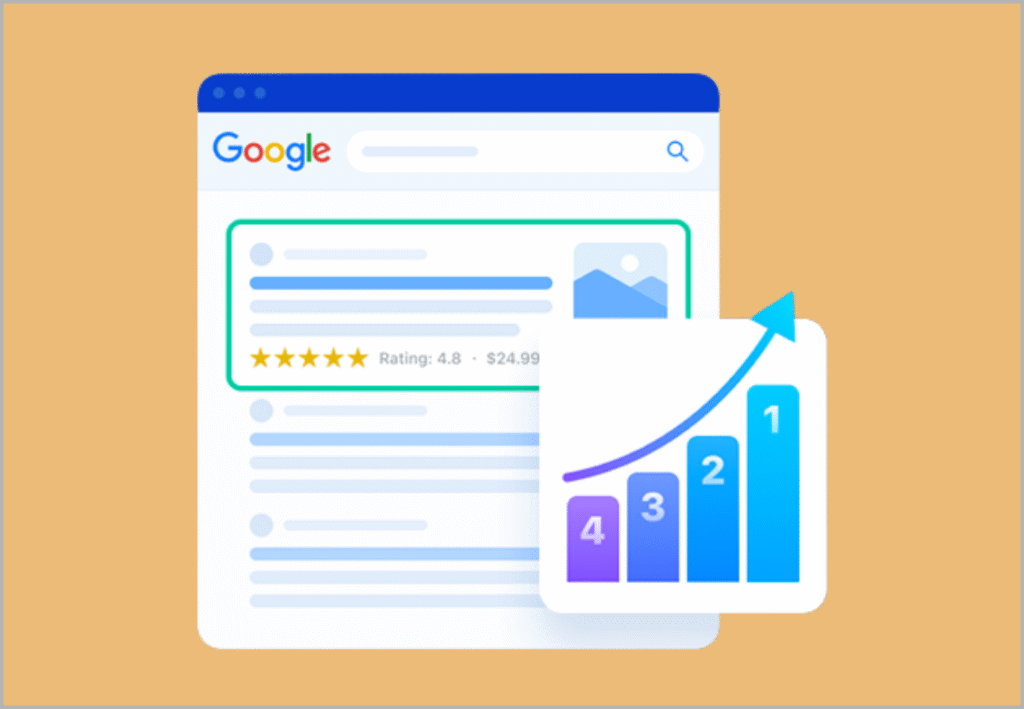
Keyword gap analysis isn’t just a tactical SEO exercise; it’s a business-growth strategy. By identifying which keywords your competitors rank for and you don’t, you gain a roadmap to close ranking disparities, strengthen content coverage, and capture missed traffic opportunities.
In 2025’s search ecosystem, this practice has become essential. With Google’s continuous algorithm updates and the rise of AI-driven SERP layouts, having partial coverage of your niche is no longer enough. You need complete topical visibility, and that starts with bridging the keyword gaps your site may be missing.
1. It Helps You Discover Hidden Keyword Opportunities
A well-executed keyword gap analysis reveals the exact phrases users search for, but your site doesn’t appear in.
These “hidden” or untapped keywords often carry significant potential:
- They may have moderate keyword difficulty (KD) but high search volume.
- They frequently align with commercial or transactional intent, ideal for product or service pages.
- They represent real search behavior, not theoretical ideas.
For example, if your competitor ranks for “semantic SEO tools” or “keyword clustering strategy,” and you only cover “SEO keyword research,” you’re missing part of the buyer’s journey. By identifying keyword gaps and filling them, you can intercept users earlier in their discovery phase and guide them toward your solution.
This insight transforms guesswork into data-backed decisions.
2. It Strengthens Your Competitive SEO Strategy
The keyword gap analysis is the foundation of competitive keyword research.
Instead of analyzing your own rankings in isolation, keyword gap analysis can help you compare keyword overlap across domains. This approach reveals:
- Shared keywords: Where competition is even.
- Weak keywords: Where you underperform.
- Missing keywords: Where competitors dominate.
By grouping these findings, you can prioritize optimization efforts more strategically:
- Improve on-page elements for weak keywords.
- Create new content for missing or untapped keywords.
- Consolidate overlapping content to avoid cannibalization.
The result is a leaner, more focused content strategy that mirrors what already works in your market.
3. It Improves Search Intent Alignment
One of the main reasons pages fail to rank isn’t poor optimization; it’s misaligned intent.
Keyword gap analysis helps you discover this by revealing the type of intent competitors target successfully.
For instance:
- Informational intent: “What is keyword gap analysis?”
- Commercial intent: “Best keyword gap tools”
- Transactional intent: “Buy SEO tool for keyword gap analysis”
When you map these intent types to your existing pages, keyword gaps refer to areas where your content doesn’t match user expectations.
Aligning your pages with the correct intent improves:
- CTR (click-through rates) in SERPs
- Engagement metrics (bounce rate, dwell time)
- Conversion potential once visitors land on your site
Modern SEO tools like Semrush and SE Ranking now automatically tag search intent, making this process more data-driven and efficient.
4. It Builds Topic Clusters and Semantic Authority
Keyword gap analysis feeds directly into topic cluster building.
By analyzing related phrases competitors use, you can:
- Identify subtopics connected to your main pillar page.
- Create supporting content that links internally to the pillar.
- Improve semantic relationships between your posts.
This strengthens your topical authority, helping Google understand that your site comprehensively covers the subject.
For example, after identifying gaps like:
- “keyword gap vs content gap”
- “keyword clustering techniques”
- “How to fill keyword gaps”
You can build interconnected articles around your main “Keyword Gap Analysis” guide.
Over time, this structure not only improves rankings but also resilience to algorithm changes, because Google recognizes your site as a trusted knowledge source.
5. It Enhances On-Page Optimization and Content Quality
Gap analysis doesn’t stop at finding missing terms; it tells you how to optimize what you already have.
You can:
- Add supporting keywords to thin or underperforming pages.
- Refine headings, meta descriptions, and internal links using discovered terms.
- Update outdated content with current keyword variations.
- Remove irrelevant or duplicate pages that compete for the same intent.
This data-backed optimization improves both ranking stability and reader experience, ensuring your pages stay competitive even in crowded niches.
6. It Creates a Scalable Content Optimization Workflow
Once you integrate keyword gap analysis into your regular SEO routine, it becomes part of a continuous content optimization system.
Here’s how that workflow looks:
- Research: Identify competitors and run a keyword gap report.
- Analyze: Filter results by KD, search volume, and intent.
- Prioritize: Assign keywords to pages or new content ideas.
- Create: Write or optimize content targeting those opportunities.
- Track: Measure ranking, traffic, and CTR changes.
- Repeat: Re-run analysis quarterly to find new gaps.
This loop ensures your site never stagnates. It constantly evolves to fill emerging keyword opportunities and create high-quality content that better meets user intent as the market shifts.
7. It Supports Data-Driven Decision Making
Perhaps the most powerful outcome is clarity.
You stop guessing what to write next.
Keyword gap analysis provides you with measurable data:
- Which keywords drive traffic for competitors?
- Which pages rank for them?
- What KD and search volume thresholds to target?
With this information, your SEO strategy becomes predictable, measurable, and scalable, three things every marketing team needs in 2025.
In short, Keyword gap analysis turns scattered data into actionable insight. It helps you find, prioritize, and capture the very opportunities competitors use to rank higher.
And in doing so, it transforms your keyword research from reactive to proactive.
Recognizing the value of keyword gap analysis sets the foundation; now it’s time to translate that understanding into action with a structured process.
How to Identify Keyword Gaps and Strengthen Your SEO Strategy: Keyword Gap Analysis (Step-by-Step Process)
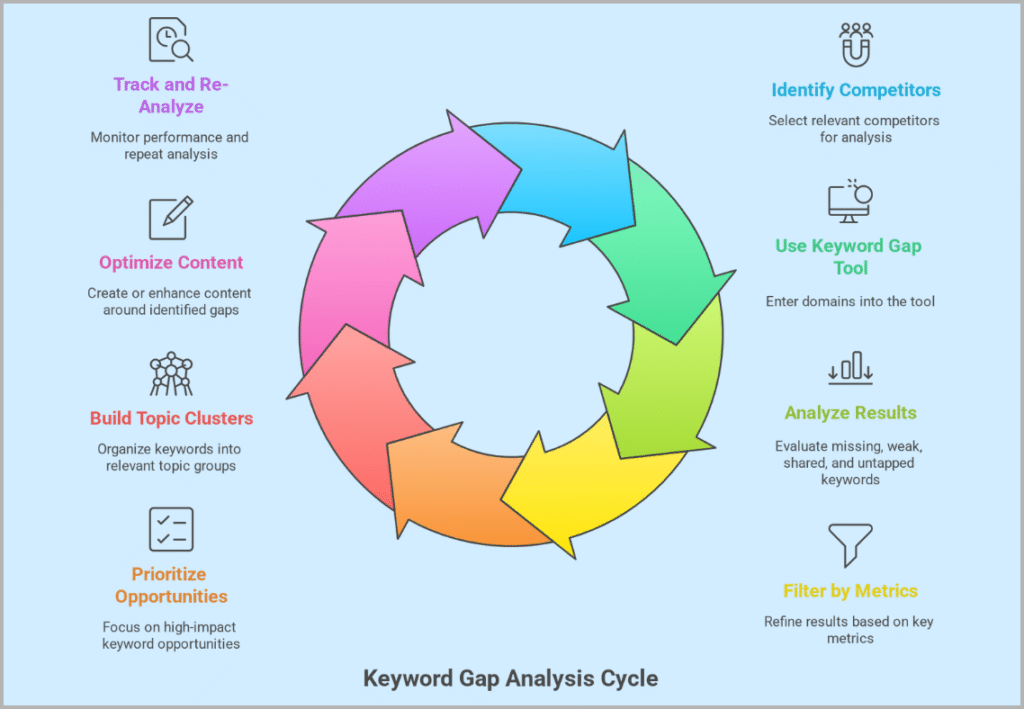
Performing a keyword gap analysis may sound complex, but once you break it into steps, it’s straightforward, repeatable, and highly rewarding.
This process reveals exactly which keywords your competitors rank for that you don’t, allowing you to fill those keyword gaps systematically.
Here’s a step-by-step guide to performing a complete keyword gap analysis using any reliable SEO tool like Semrush, Ahrefs, SE Ranking, SurferSEO, or AIOSEO.
Step 1: Identify the Right Competitors
Before comparing keyword data, you need the right set of competitors. Conducting a competitive analysis helps you identify not just direct business rivals, but the websites that rank for the same search intent as yours.
How to identify SEO competitors:
- Search your primary keywords (e.g., “keyword gap analysis,” “content gap vs keyword gap”).
- Note the top 5–10 domains consistently ranking on the first page.
- Prioritize those with similar domain authority (DA) or topical focus.
For example, if you’re an SEO blog, your SEO competitors might include SurferSEO, SE Ranking, and Semrush Blog, not necessarily large digital agencies.
Finding intent-aligned competitors ensures your keyword gap data is relevant and actionable.
Step 2: Enter Domains into a Keyword Gap Tool
Once competitors are identified, input your website and theirs into a keyword gap tool.
Most advanced tools (like Semrush or Ahrefs) allow side-by-side comparisons between 2–5 domains.
You’ll typically get a segmented report showing:
- Missing Keywords: Competitors rank; you don’t.
- Weak Keywords: You rank, but competitors rank higher.
- Shared Keywords: Both rank for similar positions.
- Untapped Keywords: Unique keywords other competitors rank for, which you haven’t targeted.
This classification provides the foundation for improving your keyword gap strategy.
Pro Tip: Always export your keyword lists for long-term tracking. Include columns for KD, search intent, volume, CTR potential, and target URL.
Step 3: Analyze the Results (Missing, Weak, Shared, Untapped)
Here’s how to interpret your data once you’ve got the results:
| Keyword Type | Description | Action Plan |
|---|---|---|
| Missing | Keywords you don’t rank for, but competitors do | Create new pages targeting these keywords |
| Weak | Keywords you rank for, but in lower positions | Optimize on-page SEO, improve backlinks, and update content |
| Shared | Keywords both you and competitors rank for | Track regularly; optimize meta titles and internal linking |
| Untapped | Keywords competitors rank for that aren’t yet saturated | Target these early for quick wins |
By categorizing your keywords this way, you can prioritize which opportunities offer the fastest growth and use each keyword to create content that drives measurable results.
Step 4: Filter by Key Metrics
After classification, apply filters to find high-potential opportunities:
- Keyword Difficulty (KD): Choose terms with manageable competition.
- Search Volume: Focus on keywords that bring consistent traffic.
- Search Intent: Check if users are looking to learn, compare, or buy.
- SERP Features: Identify keywords that trigger featured snippets, “People also ask,” or site links.
These filters ensure that you focus your efforts on keywords worth ranking for, not just any missing term.
Example:
If “how to fill keyword gaps” has a low keyword difficulty score and strong intent signals, it’s more strategic than chasing “keyword gap” alone, which may be too competitive.
Step 5: Prioritize Keyword Opportunities
Now that you have filtered your results, it’s time to score and prioritize them.
A simple way to do this is to assign an Opportunity Score:
Opportunity Score = (Search Volume × CTR Potential × Intent Weight) ÷ Keyword Difficulty
Where:
- CTR Potential: Average click-through rate for the keyword’s SERP type.
Intent Weight:
- 1.0 for informational
- 1.3 for commercial
- 1.5 for transactional
The higher the score, the more valuable the keyword is for your content strategy.
Step 6: Build Topic Clusters from Gaps
Keyword gap analysis and topic clustering work hand in hand.
Once you identify related missing keywords, group them by theme or intent to create content clusters.
Example cluster around “Keyword Gap Analysis”:
- “What is keyword gap” (pillar page)
- “Keyword gap vs content gap”
- “How to perform a keyword gap analysis”
- “Best keyword gap tools in 2025”
- “How to fill keyword gaps in content”
Interlink these articles to signal strong semantic relationships to Google.
This improves crawlability, contextual depth, and overall SEO ranking performance.
Step 7: Optimize or Create Content Around the Gaps
Now that you’ve identified and prioritized your opportunities:
- Update existing content: Add newly discovered supporting terms naturally.
- Create new content: Target missing or untapped keywords.
- Enhance on-page SEO: Optimize title tags, H2 headings, meta descriptions, and image alt text.
- Internal linking: Connect related posts to strengthen topical flow and reduce cannibalization.
The goal is to fill keyword gaps without overstuffing or diluting quality. Every addition should improve context and satisfy user intent.
Step 8: Track, Measure, and Re-Analyze Regularly to Find Keyword Gap
Keyword landscapes evolve quickly.
Set a routine to perform a keyword gap analysis every 2–3 months to:
- Track new competitor keywords.
- Identify emerging search trends.
- Monitor how your updated pages improve in rankings and organic traffic.
Tools like SE Ranking, Ahrefs, or SurferSEO allow you to create automated alerts or recurring reports, ensuring your content strategy stays current.
This continuous loop of analysis → optimization → tracking → re-analysis is what keeps successful SEO strategies ahead of the curve.
Pro Tip: Automate Your Workflow
Advanced SEO professionals now integrate NLP-based keyword clustering into this process. Using machine learning, you can:
- Detect semantic similarity between keywords.
- Perform entity recognition to identify context.
- Use topic modelling to expand clusters intelligently.
These techniques help uncover keywords beyond your competitor reports, turning data into insights your rivals may have missed.
After identifying keyword gaps, the next move is selecting the tools that help you uncover even deeper insights.
Best Keyword Gap Tools (2025 Comparison)
The effectiveness of your keyword gap analysis largely depends on the tool you choose. Each SEO platform offers a different approach to uncovering missing, weak, shared, and untapped keywords.
Below is a detailed comparison of the top keyword gap tools in 2025, so you can select one that best fits your workflow, goals, and level of expertise.
1. Semrush: Best for Comprehensive Competitive Keyword Research

Overview:
Semrush remains the benchmark for competitive keyword analysis. The Keyword Gap Tool lets you compare up to five domains at once, giving you a detailed view of the missing, weak, shared, and untapped keywords between you and your competitors.
Key Features:
- Visual “Missing / Weak / Shared / Untapped” keyword reports
- Filters by search intent, keyword difficulty (KD), and SERP features
- One-click export to Keyword Manager or Position Tracking
- Integration with content templates and topic clusters
Best For:
Marketers who need enterprise-level insights and plan long-term content gap analysis alongside SEO performance tracking.
Strengths:
- Intuitive dashboards for both beginners and professionals
- Robust filtering system for high-value keyword opportunities
- Integrates smoothly with content optimization workflows
Limitations:
- Premium pricing may not suit small projects
- Data overload if you only need a quick keyword snapshot
Use Case Example:
If your site ranks for “keyword gap analysis guide,” but competitors rank for “keyword gap Semrush” and “find missing keywords,” Semrush instantly identifies these gaps and provides intent classification to help prioritize which ones to target first.
2. Ahrefs: Best for Backlink-Integrated Keyword Gap Insights
Overview:
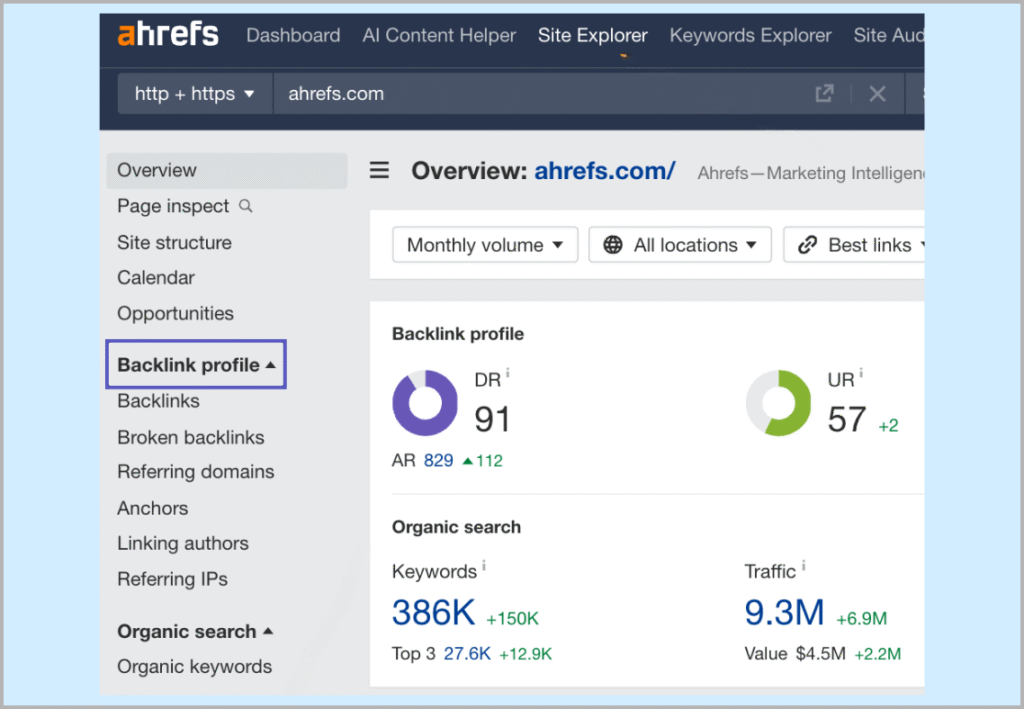
Ahrefs’ Content Gap Tool is extremely effective for identifying missing keywords while simultaneously analyzing the backlink authority of ranking pages.
Key Features:
- Compare your domain to up to 10 competitors
- Shows where competitors rank in the top 10 positions, while you don’t
- Combines keyword metrics with URL-level backlinks
- Offers keyword overlap and ranking distribution charts
Best For:
Advanced SEOs and content strategists who want keyword + backlink insights in a single view.
Strengths:
- Excellent data accuracy and frequent SERP updates
- Reveals link-based ranking advantages for each keyword
- Perfect for competitive keyword gap analysis with authority mapping
Limitations:
- Interface requires familiarity; it is less beginner-friendly
- Lacks built-in intent filters (manual tagging required)
Use Case Example:
You can find keywords where your competitors not only rank higher but also possess stronger backlinks, helping you decide whether to focus on on-page SEO or link building.
3. SE Ranking: Best for Agencies and Collaborative Teams

Overview:
SE Ranking’s Keyword Gap & Competitor Research Tool delivers highly accessible insights with a clean interface and affordable pricing, making it ideal for agencies managing multiple websites.
Key Features:
- Compare up to five domains
- Detailed breakdown by organic, paid, and local keywords
- Filter results by search volume, KD, and intent
- Exportable reports for client presentations
Best For:
SEO teams and digital agencies are looking for white-label reports and collaborative keyword analysis.
Strengths:
- Cost-effective with enterprise-quality data
- Offers gap segmentation by region and search type
- Integrates with SE Ranking’s Content Editor for seamless optimization
Limitations:
- Slightly slower data refresh rate than Ahrefs or Semrush
- Doesn’t visualize keyword clusters automatically
Use Case Example:
Ideal for agencies comparing multiple client domains. You can run gap analyses for each client, export missing keywords, and build optimized content plans using SE Ranking’s internal editor.
4. SurferSEO: Best for Content Optimization and Semantic Gap Analysis

Overview:
SurferSEO focuses less on pure keyword lists and more on content relevance. Its Keyword Surfer & Content Planner helps identify semantic keyword gaps through NLP-based clustering and content scoring.
Key Features:
- AI-driven keyword clustering
- Content Planner for topic gap discovery
- On-page scoring for missing semantic terms
- Integration with Google Docs for real-time optimization
Best For:
Writers and content marketers who want to fill keyword gaps directly within content creation.
Strengths:
- Simplifies semantic keyword optimization
- Prioritizes topic clusters over raw keyword lists
- Excellent for improving content quality and contextual coverage
Limitations:
- Focused on content gaps; not ideal for domain-level comparisons
- Keyword volume data is less comprehensive than Semrush or Ahrefs
Use Case Example:
If your article ranks for “keyword gap analysis steps” but lacks semantic coverage for related NLP terms like “opportunity scoring” or “topic modelling,” SurferSEO highlights and scores those missing entities automatically.
5. AIOSEO: Best for WordPress Users
Overview:
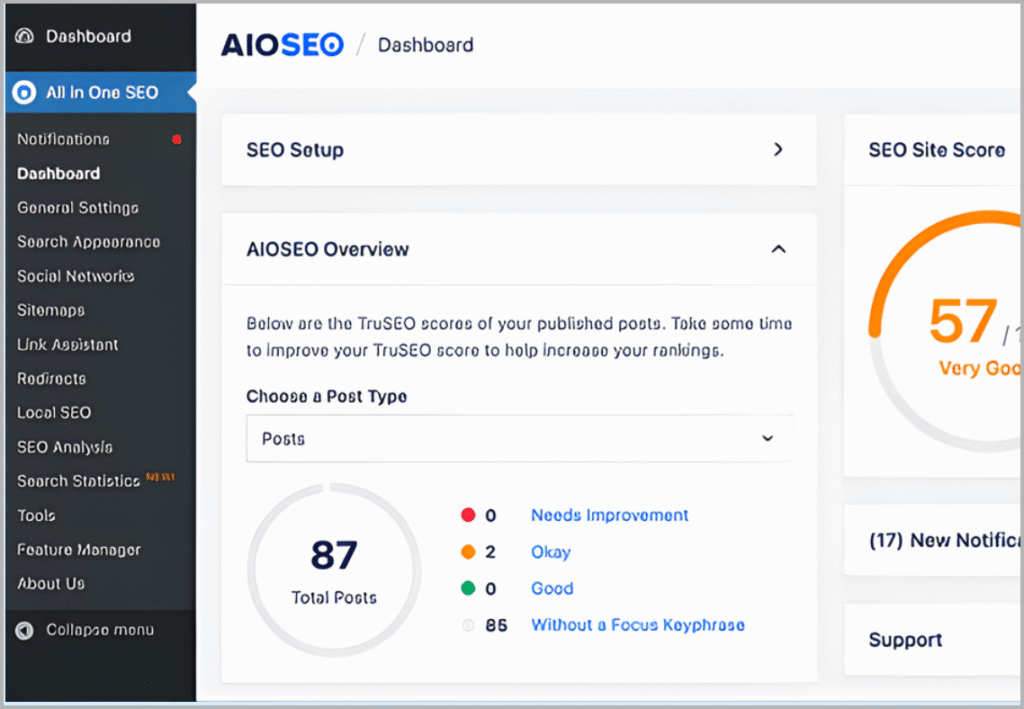
AIOSEO integrates directly with WordPress and uses Semrush’s database to offer a simplified keyword gap analysis workflow within your website dashboard.
Key Features:
- Built-in keyword research and competitor analysis widget
- Pulls keyword data from Semrush API
- On-page SEO recommendations for missing keywords
- Perfect for quick content gap identification
Best For:
WordPress site owners, bloggers, and beginners who want an easy, code-free keyword gap workflow.
Strengths:
- Native WordPress integration
- Actionable on-page optimization tips
- Beginner-friendly dashboards
Limitations:
- Limited data compared to standalone SEO suites
- Focused mainly on on-page optimization, not full-scale analysis
Use Case Example:
Ideal for content creators updating posts directly from WordPress. You can instantly find keyword opportunities you’re missing and optimize your meta tags, H2s, and titles without switching tools.
Quick Feature Comparison to Identify and Fill Content Gaps
| Tool | Keyword Segmentation | Intent Filter | Topic Clustering | Pricing Tier | Ideal For |
|---|---|---|---|---|---|
| Semrush | Missing / Weak / Shared / Untapped | ✅ | ✅ | High | Comprehensive SEO research |
| Ahrefs | Content Gap | ⚪ (Manual) | ⚪ | High | Technical SEO & link insights |
| SE Ranking | Missing / Shared / Paid / Local | ✅ | ⚪ | Mid | Agencies & teams |
| SurferSEO | Semantic & NLP-based | ✅ | ✅ | Mid | Content marketers |
| AIOSEO | Simplified (via Semrush API) | ⚪ | ⚪ | Low | WordPress users |
✅ = Available ⚪ = Partial/Manual
How to Choose the Right Tool to Perform a Content Gap Analysis
- For holistic SEO coverage: go with Semrush.
- For backlink-aware keyword strategy: choose Ahrefs.
- For agencies or multiple clients: pick SE Ranking.
- For content teams focusing on NLP & semantic gaps: use SurferSEO.
- For WordPress-based sites: start with AIOSEO.
The best approach? Use one tool for discovery (Semrush/Ahrefs) and another for semantic refinement (SurferSEO).
Together, they form a complete keyword gap workflow, from detection to optimization.
Once you uncover those opportunities, you need a clear plan to fill the gaps effectively and strengthen your overall keyword strategy. Let’s explore how to turn those tool insights into practical, ranking-focused actions that actually move your site up the SERPs.
How to Fill Keyword Gaps Effectively: Improving Your Keyword Strategy
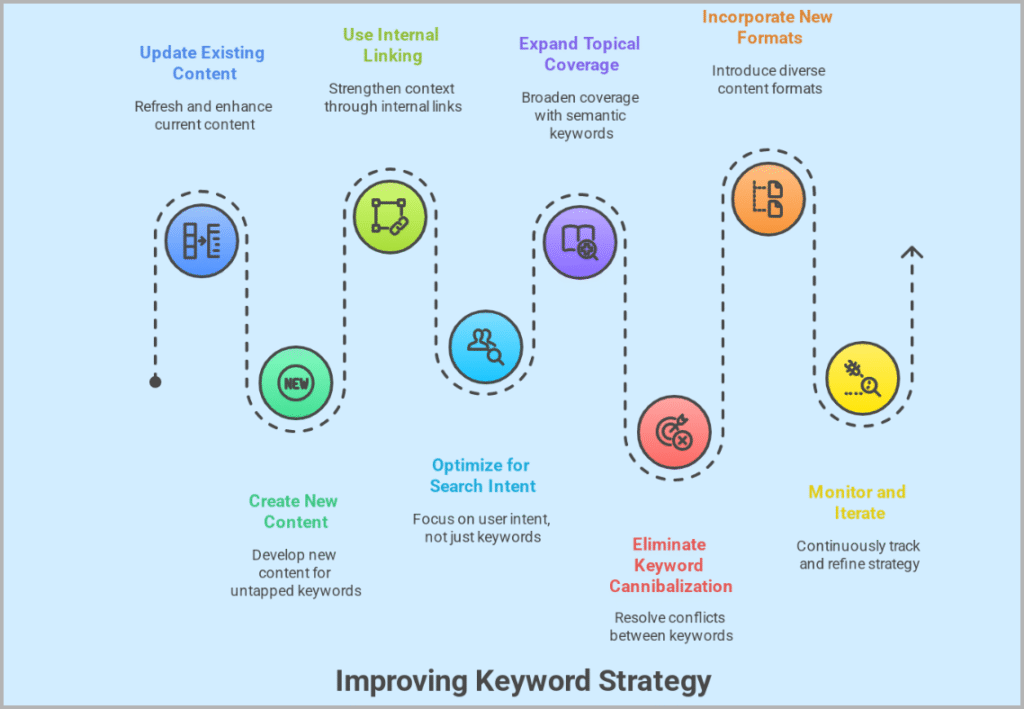
Keyword gap analysis identifies keywords and gives you a map, but filling those keyword gaps in your content is what drives results. Once you know which keywords your competitors rank for and which they don’t, the next step is to integrate them into your content and website structure strategically.
Filling keyword gaps isn’t just about adding new phrases. It’s about improving content quality, semantic coverage, and user intent satisfaction, all while maintaining clarity and topical authority.
Let’s go through practical, data-driven ways to fill keyword gaps effectively in 2025.
1. Update and Optimize Existing Content
The easiest wins often come from your existing content. These are pages already indexed, possibly ranking on page 2 or 3 for valuable queries.
Steps to optimize them:
- Revisit your on-page SEO: update meta titles, descriptions, and H2 tags with newly discovered missing keywords.
- Integrate semantic terms naturally within paragraphs, e.g., “keyword clustering,” “search intent,” “content optimization workflow.”
- Use tools like SurferSEO or Frase to identify LSI keywords and semantic phrases missing from your copy.
- Include a “People Also Ask” section or mini FAQ using queries found in your SERP features report.
Updating content based on keywords not only fills the weak keyword gaps but also signals freshness to Google, improving click-through rates and time on page.
2. Create New Content for Missing or Untapped Keywords
For keywords your site doesn’t rank for at all, the missing and untapped ones, new content creation is essential.
Here’s how to prioritize what to write:
- Start with medium-difficulty (KD 30–50) keywords that show commercial or transactional intent.
- Build topic clusters around them, connecting new articles to your pillar page (e.g., this guide).
- For each missing keyword, create a piece that answers search intent completely, not just superficially.
Example:
If your competitors rank for “how to do keyword gap analysis” and you only have a “keyword gap definition” article, create a detailed tutorial post with step-by-step visuals and internal links to supporting pages.
Remember: relevance > repetition. Google rewards depth, not density.
3. Use Internal Linking to Strengthen Context
Internal links act as SEO signals that connect related content topics.
When you fill keyword gaps, make sure those new or updated pages are interlinked correctly.
Best practices for internal linking:
- Link from high-authority pages to new content using descriptive anchor text (avoid exact-match anchors).
- Create topic clusters, where all supporting articles link back to the main pillar page.
- Ensure every new page has at least 2–3 incoming links from relevant content.
Add contextual links in sentences, not just “See also” lists at the bottom.
This approach not only passes authority but also helps Google understand the semantic structure of your website.
4. Optimize for Search Intent, Not Just Keywords
Sometimes a keyword gap exists because your current pages don’t match the right intent, not because you’re missing the keyword.
For example:
- Your page is informational (“What is keyword gap analysis?”),
- But the competitor ranks with a commercial intent page (“Best keyword gap tools”).
Fix this by:
- Aligning content type (guide, comparison, checklist) with search intent.
- Adjusting tone and format to reflect user goals, learning vs purchasing.
- Using intent-based modifiers like “best,” “tools,” “examples,” or “how-to.”
The result: higher engagement, better dwell time, and a better match with user needs.
5. Expand Your Topical Coverage with Semantic Keywords
Filling keyword gaps also means strengthening semantic relevance, the network of concepts around your core topic.
Use NLP-based keyword extraction or topic modelling to find related terms and entities.
Examples of semantic keywords for this topic:
- “keyword overlap”
- “content gap vs keyword gap”
- “opportunity scoring”
- “semantic similarity”
- “competitive keyword research”
Adding these related terms in natural contexts enhances Google’s understanding of your page and improves ranking for multiple search variations.
6. Eliminate Keyword Cannibalization
As you add new content and optimize existing pages, it’s possible that multiple URLs begin targeting the same term, leading to keyword cannibalization.
How to prevent it:
- Use your keyword list spreadsheet to map one primary keyword per page.
- Merge similar articles that target the same search intent.
- Redirect outdated or duplicate posts to the stronger, updated one.
- Add clear internal hierarchies (pillar → cluster → support).
This ensures every page serves a distinct purpose and contributes to your site’s overall topical authority.
7. Incorporate New Content Formats
Sometimes, filling these gaps doesn’t require another blog post; it needs diversification.
For competitive terms, explore content formats that outperform traditional articles:
- Comparison guides (“Semrush vs Ahrefs keyword gap features”)
- Video tutorials embedded within articles
- Infographics explaining keyword gap workflows
- Downloadable templates for keyword research sheets
These types of content not only enhance engagement but also improve visibility in SERP features like videos, images, and snippets.
8. Monitor and Iterate
- After publishing or updating your pages:
- Track your new keywords using Position Tracking or Google Search Console.
- Compare before-and-after metrics (rankings, CTR, impressions).
Re-run gap analyses quarterly to find new opportunities.
SEO is cyclical; your competitors will keep optimizing, and so should you. A consistent iteration schedule ensures your site remains the one closing gaps fastest.
Pro Tip: Align Gap Filling with Business Goals
Not every keyword is worth chasing.
Focus on specific keywords that connect to your products, services, or conversion funnels.
For example:
- Informational gap → blog post → newsletter CTA
- Commercial gap → comparison page → demo form
- Transactional gap → landing page → purchase CTA
This ensures every piece of content update contributes directly to ROI, not just rankings.
In short:
Filling keyword gaps is where strategy meets execution.
It’s about merging competitive insights with on-page precision, updating, creating, and linking with intent.
The result? Broader visibility, stronger authority, and an SEO structure that scales organically.
Real-World Example: Filling Keyword Gaps in Action
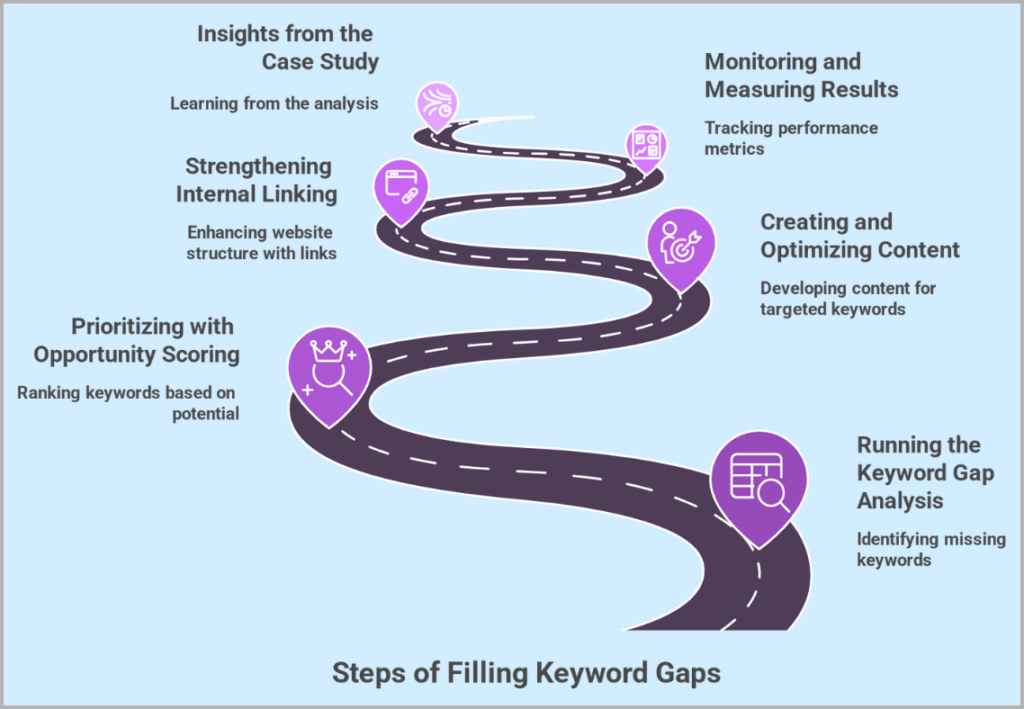
Theory means little without proof. To see the true impact of keyword gap analysis, let’s walk through a practical example that shows how a data-driven SEO workflow can uncover hidden content opportunities, fill keyword gaps, and deliver measurable ranking growth.
The Scenario
A mid-sized SaaS company offering marketing-automation software had strong visibility for branded and product-related queries like
“email automation platform” and “marketing funnel builder.”
However, organic traffic plateaued.
After an audit, the team discovered a major blind spot: they weren’t ranking for comparison, educational, or how-to queries that potential customers searched before purchase, keywords your competitors are ranking for and dominating in the search results.
In other words, they had serious keyword gaps.
Step 1: Running the Keyword Gap Analysis
Using Semrush and SE Ranking, they compared their domain with three direct competitors.
Findings:
- 430 missing keywords (competitors ranked Top 20; they didn’t appear)
- 270 weak keywords (their rankings > 15 while competitors sat Top 5)
- 140 shared keywords (healthy overlap)
- 80 untapped keywords (ranked by secondary competitors, unaddressed in their content)
Among the missing terms were high-intent queries such as:
- “email automation vs CRM”
- “marketing funnel examples”
- “best tools for lead nurturing”
Each keyword represented a gap between what their audience was searching and what their site offered.
Step 2: Prioritizing with Opportunity Scoring
The SEO team filtered results by search intent, volume, and keyword difficulty (KD) to locate realistic wins.
They applied a simple Opportunity Score formula:
Opportunity Score = (Search Volume × CTR Potential × Intent Weight) ÷ KD
Keywords scoring > 40 became immediate targets. These typically had:
- KD < 45
- Commercial intent
- Monthly search volume ≥ 500
High-value examples included:
- “How to automate email workflows” (Score = 68)
- “marketing automation examples” (Score = 54)
Step 3: Creating and Optimizing Content
Armed with prioritized data, the content team built a topic cluster around “Marketing Automation Workflows.”
Pillar page: What Is Marketing Automation and How It Works
Supporting posts:
- How to Automate Email Workflows Step by Step
- Marketing Automation Examples and Templates
- Best Tools for Lead Nurturing in 2025
- Marketing Automation vs CRM – Key Differences
Each article targeted one primary keyword plus semantic variants such as “workflow automation,” “lead sequence,” and “campaign builder.”
They optimized on-page elements:
- Titles and H2s with missing keywords
- NLP-driven phrases for semantic similarity
- Links that point back to the main pillar page
- FAQ sections matching “People Also Ask” queries
Step 4: Strengthening Internal Linking
After publishing, they linked from high-authority pages (case studies, pricing, blog homepage) to the new cluster using descriptive anchors like “learn how to automate email workflows” and “compare marketing automation tools.”
This internal linking:
- Distributed link equity toward new posts
- Helped search engines map semantic relationships
- Reduced keyword cannibalization by clarifying topical boundaries
Step 5: Monitoring and Measuring Results
Using Google Search Console and Semrush Position Tracking, they monitored progress across all new and updated URLs.
Results after 90 days:
| Metric | Before | After |
|---|---|---|
| Ranking Keywords | 2,600 | 3,950 (+52%) |
| Avg. Position | 27.4 | 15.2 |
| Click-Through Rate (CTR) | 2.8 % | 4.7 % |
| Monthly Organic Traffic | 22 k | 33 k (+50 %) |
| Conversions (Free Trials) | 440 | 685 (+56 %) |
Several posts, such as “How to Automate Email Workflows,” reached the Top 5 SERP positions, even earning a featured snippet.
Step 6: Insights from the Case Study
The improvements weren’t random. They aligned precisely with the keyword gap workflow:
| Phase | Impact |
|---|---|
| Gap Analysis | Identified data-backed content topics |
| Prioritization | Focused resources on realistic wins |
| Creation | Added new, intent-specific articles |
| Optimization | Enhanced existing content |
| Internal Links | Strengthened authority and context |
| Monitoring | Measured ROI with rank and conversion data |
By repeating this process quarterly, the company now uses keyword gap analysis as part of its content governance system, ensuring every new campaign starts with competitive insight.
Why This Works Across Industries
Whether you run a blog, e-commerce store, or local business website, this same framework applies:
- Audit your content using a keyword gap tool.
- Segment opportunities by intent and difficulty.
- Create or optimize pages to address missing and weak terms.
- Link them into existing clusters.
- Measure results and iterate quarterly.
The difference between mediocre and exceptional SEO often lies in how consistently you act on these insights.
Pro Tip: Build Visual Proof for Stakeholders
Turn your keyword gap results into visual data, charts comparing “Before vs After” keyword coverage or traffic growth.
Stakeholders and clients respond better to visual ROI than raw spreadsheets.
This not only justifies budget allocation but also positions SEO as a measurable growth channel.
Summary
This real-world example shows how keyword gap analysis transforms guesswork into an evidence-driven system.
By systematically identifying, prioritizing, and filling gaps, the SaaS brand captured new traffic, built topical authority, and improved conversion rates, all without increasing ad spend.
Advanced Tips: Using NLP and Semantic SEO to Find Hidden Keyword Gaps
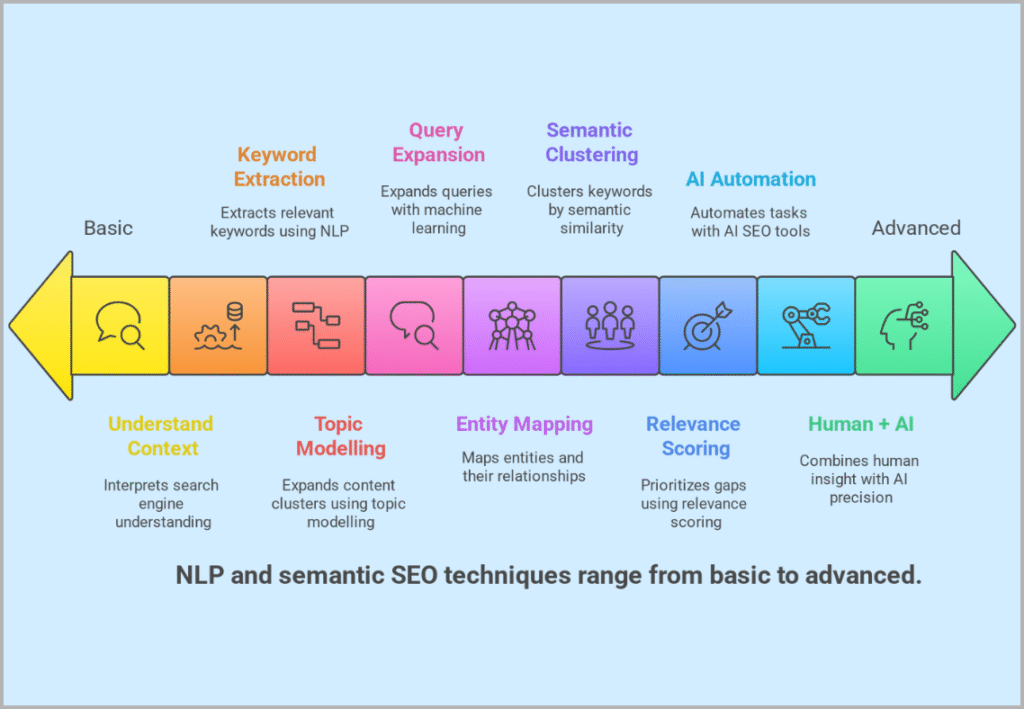
Traditional keyword gap tools show what competitors already rank for. But in 2025, SEO growth comes from discovering the opportunities they don’t see yet.
That’s where Natural Language Processing (NLP) and Semantic SEO come in, helping you uncover hidden keyword gaps based on context, entities, and user intent rather than exact phrases.
These advanced methods go beyond matching words; they map meaning.
1. Understand How Search Engines Interpret Context
Google no longer ranks pages solely on keyword frequency.
Its models, such as BERT and MUM, analyze semantic similarity, entity relationships, and topic relevance.
For example, if you optimize for “keyword gap analysis,” Google automatically associates your page with related entities like “competitive research,” “topic clusters,” and “content gap analysis.”
To perform at this level, you must write content that covers concepts, not just keywords, weaving related terms, synonyms, and contextually relevant questions throughout your copy.
2. Apply NLP-Based Keyword Extraction
NLP keyword extraction identifies salient terms directly from competitor pages or top-ranking content.
You can use tools such as RAKE, YAKE, or AI-powered platforms like Frase, SurferSEO, or NeuronWriter to automatically extract and weight key phrases.
Workflow Example:
- Collect the top 10 SERP URLs for your target query.
- Run an NLP keyword extraction to find recurring entities and co-occurring phrases.
- Group them by semantic theme (e.g., “gap analysis,” “competitor research,” “keyword clusters”).
- Integrate these terms naturally into your headings, FAQs, and anchor texts.
Result: broader coverage and higher relevance scoring in Google’s semantic index.
3. Use Topic Modelling to Expand Content Clusters
Topic modelling algorithms like LDA (Latent Dirichlet Allocation) or BERT Embeddings identify how keywords connect within a niche.
When applied to SEO, they reveal content topics your competitors haven’t addressed.
Example:
A model trained on “keyword gap analysis” content might surface hidden topics such as:
- “opportunity scoring formula”
- “semantic keyword grouping”
- “AI SEO automation for keyword research”
Adding these subtopics strengthens your topic clusters and increases your chance of ranking for long-tail searches and AI Overviews.
4. Perform Query Expansion with Machine Learning
Query expansion uses algorithms to predict how users phrase similar searches.
For example, the term “keyword gap tool” may expand into:
- “best keyword gap software”
- “Compare keyword research tools”
- “How to find untapped keywords”
You can automate this by combining Google Autocomplete, People Also Ask, and NLP transformers (e.g., SBERT) to generate context-aware variations.
These expansions guide you to cover user language diversity, which increases impressions and click reach.
5. Map Entities and Relationships
Entity recognition helps identify who, what, and where your content should reference.
For a keyword-gap page, relevant entities might include:
- Tools: Semrush, Ahrefs, SE Ranking, SurferSEO
- Concepts: Keyword difficulty, search intent, topic clustering
- Metrics: CTR, search volume, ranking distribution
Mentioning, comparing, and interlinking these entities clarifies your topical scope for Google’s Knowledge Graph, boosting both relevance and credibility.
6. Cluster Keywords by Semantic Similarity
Rather than grouping purely by shared stems, cluster using cosine-similarity scoring from NLP embeddings.
This method groups phrases by meaning, for instance:
| Semantic Cluster | Example Keywords |
|---|---|
| Competitor Research | keyword gap analysis, competitive keyword research, find competitor keywords |
| Opportunity Prioritization | opportunity scoring, keyword value matrix, ranking potential |
| Content Optimization | fill keyword gaps, optimize existing content, improve on-page SEO |
Each cluster can become a topic hub, interlinked through pillar and supporting pages.
7. Use Relevance Scoring to Prioritize Hidden Gaps
Relevance scoring merges semantic similarity with search volume and intent metrics.
By assigning numerical weights to each keyword’s contextual fit, you can pinpoint high-value yet underused terms.
Formula Example:
Relevance Score = (Semantic Similarity × Intent Weight × CTR Potential) ÷ KD
A relevance score above 0.7 indicates a strong match for your niche, even if volume is modest, ideal for early-stage content that ranks fast.
8. Leverage AI SEO Tools for Automation
Modern AI SEO suites integrate these NLP principles automatically:
- SurferSEO uses NLP terms for on-page semantic optimization.
- Frase suggests contextually related questions.
- NeuronWriter applies topic modelling to draft outlines.
- Search Atlas integrates keyword extraction with competitive data.
Automating this layer allows you to perform continuous semantic gap analysis without manually re-clustering keywords.
9. Combine Human Insight + AI Precision
AI uncovers patterns; humans interpret intent.
Once you have NLP-based clusters:
- Review them for search intent fit (are they informational, commercial, transactional?).
- Remove irrelevant or overly technical topics.
- Draft outlines that connect semantic subtopics in logical order.
This human-AI synergy ensures your content remains authentic, authoritative, and conversion-driven.
10. Measure Semantic Impact
After implementation, track improvements in:
- Average Topical Relevance Score (via content tools)
- Keyword diversity: number of unique queries per page
- SERP feature visibility: snippets and AI Overviews
- Organic CTR and session duration
Pages optimized with NLP terms tend to capture a wider range of long-tail keywords and maintain stronger rankings over time.
Summary
Using NLP and semantic SEO transforms keyword gap analysis from a static audit into a living intelligence system.
You no longer just close gaps, you anticipate them.
By leveraging keyword extraction, topic modelling, and semantic clustering, your site evolves with search behavior, capturing both direct queries and contextual variations that competitors overlook.
This is the future of keyword gap analysis: data-driven, semantically rich, and continuously adaptive.
Keyword Gap Analysis for Different Business Types
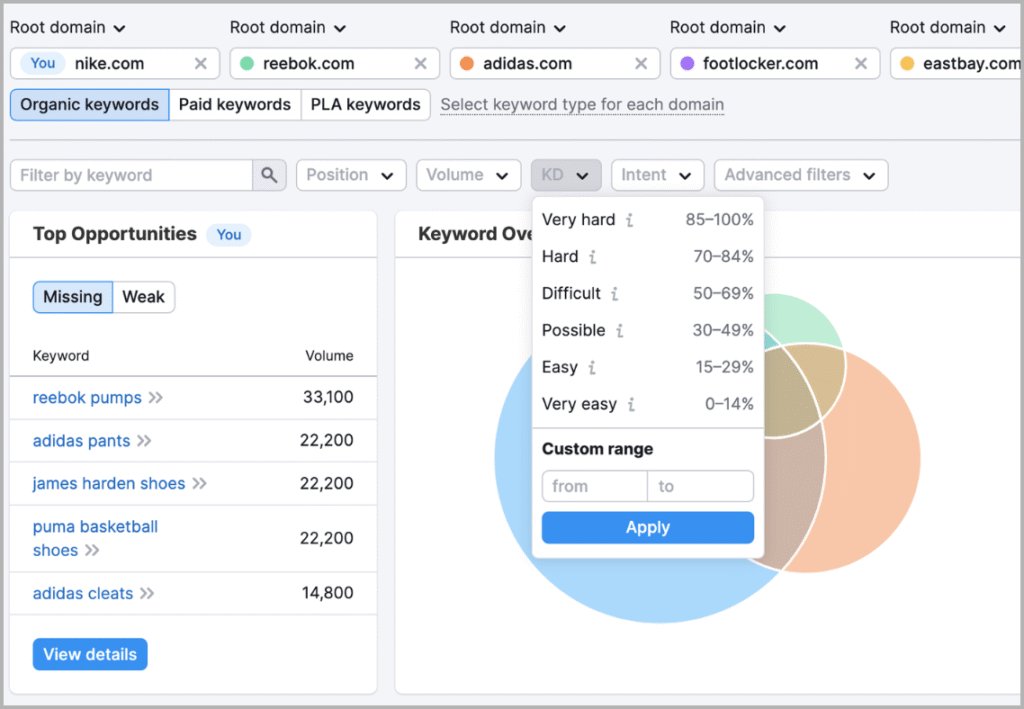
Every business has unique search patterns, customer journeys, and content structures. The keyword gap analysis process stays the same, but the way you interpret and act on the data varies by industry.
Let’s look at how to apply keyword gap insights effectively for eCommerce, SaaS, and Local SEO businesses, three of the most common segments online today.
1. Keyword Gap Analysis for eCommerce Sites
Objective: Identify product-driven and intent-driven gaps that directly influence purchase decisions.
Common Challenge: eCommerce stores often have solid product pages but weak informational or comparison content. As a result, they miss mid-funnel keywords like “best,” “cheap,” “vs,” or “reviews.”
How to Apply Keyword Gap Analysis:
- Run competitor gap reports using top online retailers or niche stores (e.g., for electronics, compare against Amazon or Best Buy; for fashion, ASOS or Zara).
- Focus on transactional keywords such as:
“buy [product] online,” “best [product] 2025,” “affordable [brand] alternatives.” - Identify untapped category-level terms (“gaming monitors under 300,” “eco-friendly yoga mats”).
- Add long-tail informational content to capture early-stage shoppers (“how to choose the right gaming monitor”).
Action Plan:
- Create buying guides and comparison pages targeting missing product clusters.
- Update meta titles with commercial modifiers (“Buy,” “Deals,” “Discount”).
- Link blog guides to product listing pages (PLPs) and product detail pages (PDPs).
- Track conversion metrics, not just rankings, to ensure keyword gap closures drive sales.
Outcome:
When implemented correctly, eCommerce brands not only gain traffic but also increase conversion rate optimization (CRO) because users find exactly what they searched for.
2. Keyword Gap Analysis for SaaS Companies
Objective: Capture high-intent leads and establish authority across every stage of the buyer journey, from education to evaluation to purchase.
Common Challenge: SaaS companies typically dominate for branded terms but lack coverage across problem-aware or solution-aware keywords.
For example, ranking for “project management software” is good, but missing “how to organize team projects” means losing valuable top-funnel awareness.
How to Apply Keyword Gap Analysis:
- Compare against 3–5 SaaS competitors with overlapping product categories.
- Look for untapped and weak keywords around:
- Use cases (“CRM for real-estate agents”)
- Features (“automated task scheduling”)
- Alternatives (“[tool] vs [tool]”)
- Integrations (“connect Slack to CRM”)
- Use intent filters to separate informational, commercial, and transactional gaps.
Action Plan:
- Build pillar pages for product categories (e.g., Project Management, CRM, Marketing Automation).
- Create supporting content (tutorials, templates, case studies) around missing topics.
- Use internal linking between “what is,” “how-to,” and “vs” articles.
- Optimize each article for semantic similarity using NLP keywords like workflow automation, user onboarding, and feature comparison.
- Refresh older content quarterly based on opportunity scoring changes.
Outcome:
SaaS companies using this strategy typically see faster movement in non-branded organic traffic and better lead conversion, as users discover their product earlier in the funnel.
3. Keyword Gap Analysis for Local SEO Businesses
Objective: Dominate geographically-specific searches and outperform competitors within target service areas.
Common Challenge: Local businesses often underuse geo-modified keywords and fail to structure pages for neighborhood-level intent.
How to Apply Keyword Gap Analysis:
- Compare against 3–4 local competitors ranking in Google’s map pack and organic listings.
- Search for missing or weak keywords that include:
1. City names (“plumber in Austin,” “SEO consultant in Toronto”)
2. Service modifiers (“24-hour,” “affordable,” “near me”)
3. Local intent triggers (“open now,” “same-day service”)
- Identify local content gaps, for example, no FAQ or service-area pages optimized for nearby suburbs.
Action Plan:
- Create dedicated landing pages per major city or region.
- Add localized schema markup (Business name, Address, Phone).
- Build city-specific blog content (“Top 5 bathroom remodel tips in Chicago”).
- Interlink service pages with location pages to strengthen topical geography signals.
- Encourage local backlinks (directories, associations, community blogs).
Outcome:
Local sites using keyword gap analysis can quickly climb in map pack visibility and organic rankings, especially when combining content optimization with Google Business Profile updates.
4. How to Customize the Workflow by Business Type
| Business Type | Primary Focus | Key Metrics | Ideal Frequency |
|---|---|---|---|
| eCommerce | Product & category keywords | Sales / CRO | Monthly |
| SaaS | Feature, problem, & solution keywords | Free-trial signups / Leads | Quarterly |
| Local SEO | Geo-targeted keywords | Calls / Directions / Bookings | Monthly |
No matter the industry, the formula stays the same:
Compare → Identify → Prioritize → Create → Measure → Repeat.
5. Combine Business Goals with Keyword Intent
Each business type also benefits from aligning gap insights with buyer-journey stages:
| Funnel Stage | eCommerce Example | SaaS Example | Local Example |
|---|---|---|---|
| Informational | “How to choose a washing machine” | “What is CRM software?” | “best roofing materials” |
| Commercial | “best washing machines 2025” | “CRM vs spreadsheet” | “affordable roofers near me” |
| Transactional | “Buy a washing machine online.” | “book CRM demo” | “Call roofing company today.” |
Mapping keywords this way ensures that every piece of content, from guides to landing pages, supports measurable business objectives.
6. Key Takeaway
The keyword gap process isn’t one-size-fits-all.
It’s an adaptable system that fits the logic of any business model.
For eCommerce, it drives product visibility.
For SaaS, it fuels content leadership and lead generation.
For Local SEO, it anchors geographic dominance.
By tailoring the same analysis method to your vertical, you transform keyword data into strategic growth plans—grounded in user intent and measurable outcomes.
Measuring Success After Keyword Gap Analysis
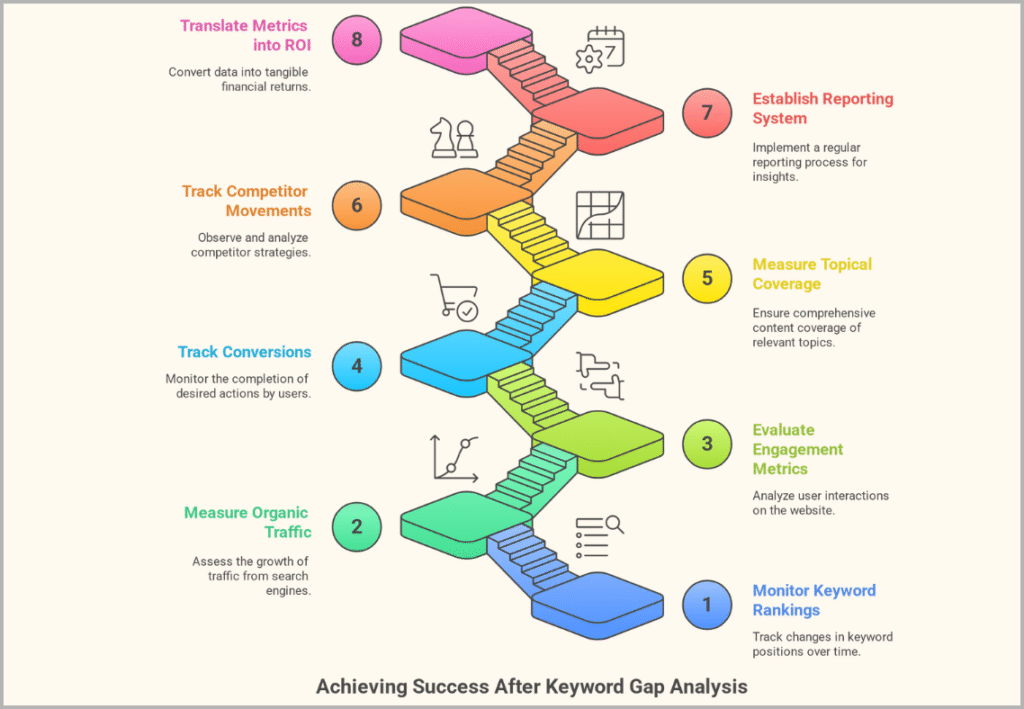
Running a keyword gap analysis and filling content gaps is only half the battle.
To ensure your efforts translate into measurable growth, you must track progress through data — from rankings to revenue.
Measuring success isn’t about vanity metrics; it’s about understanding how effectively your keyword optimization impacts SEO performance, organic traffic, and conversions.
Here’s how to evaluate the ROI of your keyword gap strategy, step by step.
1. Monitor Keyword Rankings Over Time
The most immediate indicator of success is your keyword ranking movement.
After implementing changes, track improvements for:
- Missing keywords that now rank within the Top 50 or Top 10.
- Weak keywords that move up several positions.
- Shared keywords that maintain or gain ground against competitors.
Use position tracking tools (Semrush, SE Ranking, Ahrefs, or Google Search Console) to monitor these shifts weekly.
What to watch:
- Average position change: Are rankings improving steadily?
- Top 3 / Top 10 count: How many new keywords have entered premium SERP zones?
- SERP feature wins: Are your pages appearing in featured snippets, People Also Ask, or AI Overviews?
Example metric table:
| Category | Before | After 90 Days |
|---|---|---|
| Keywords in Top 10 | 230 | 415 |
| Average Position | 26.3 | 14.7 |
| Featured Snippets Earned | 5 | 18 |
Ranking growth validates that your gap-filling strategy is working on a technical and topical level.
2. Measure Organic Traffic Growth
Next, monitor organic sessions in Google Analytics or GA4.
You should see gradual increases in both:
- Page-level traffic (especially for newly optimized URLs)
- Overall organic share (proportion of total site traffic coming from organic search)
Key indicators of success:
- Increased impressions and clicks in Google Search Console.
- New landing pages are gaining consistent traffic within 4–8 weeks.
- Reduced dependency on branded searches as non-branded keywords start performing.
This shows your site is capturing broader search demand and ranking for new semantic variations found during the gap analysis.
3. Evaluate Engagement Metrics
Improving rankings is one thing; keeping users engaged is another.
To confirm your new content satisfies search intent, monitor engagement metrics like:
- Average time on page
- Bounce rate (GA4 → engagement rate)
- Scroll depth
- Click-through rate (CTR) from SERPs
If your keyword gap content is well-aligned with intent, you’ll notice:
- Higher CTRs (titles and meta descriptions match user expectations)
- Longer dwell time (users find content valuable)
- Fewer bounces (content fulfills query needs)
Benchmark tip:
Aim for a CTR above 4% and average engagement time exceeding 90 seconds on top-performing articles.
4. Track Conversions and Goal Completions
The ultimate goal of keyword optimization is not traffic, it’s conversion.
For commercial sites, this could mean:
- Product purchases (eCommerce)
- Free trial signups (SaaS)
- Calls or bookings (Local SEO)
- Newsletter or lead magnet downloads (blogs or agencies)
Assign conversion goals in GA4 or your CRM, and attribute them to pages created or optimized during your keyword gap project.
Example metrics:
| Conversion Type | Before | After 3 Months | % Growth |
|---|---|---|---|
| Free Trial Signups | 420 | 620 | +47% |
| Product Sales | 180 | 255 | +42% |
| Form Submissions | 95 | 135 | +42% |
This confirms that filling keyword gaps contributes directly to business outcomes, not just vanity metrics.
5. Measure Topical Coverage and Semantic Relevance
Beyond rankings and conversions, evaluate how your site’s topical authority has evolved.
Use SEO tools with topic clustering or semantic analysis (SurferSEO, Frase, or NeuronWriter) to measure:
- Keyword diversity (unique keywords per page)
- Topic coverage depth (how well related entities are represented)
- Content score or topical relevance score
Improving these indicators strengthens your overall domain authority and makes future rankings easier to achieve.
6. Track Competitor Movements
Since keyword gap analysis is competitive by nature, revisit your competitors periodically.
Ask:
- Have they started targeting the same missing keywords you just covered?
- Are they gaining or losing rankings on those terms?
- Has their organic visibility dropped relative to yours?
Tools like Semrush’s Keyword Gap, Ahrefs’ Rank Tracker, or SE Ranking’s Competitor Research let you visualize this movement side-by-side.
A positive outcome isn’t just higher traffic for you—it’s also a relative decline in competitor visibility.
7. Establish a Continuous Reporting System
Keyword landscapes evolve quickly, so create a repeatable measurement system:
- Monthly: Track keyword rankings and traffic metrics.
- Quarterly: Re-run keyword gap analysis to find new opportunities.
- Biannually: Audit content performance and prune underperforming pages.
- Annually: Benchmark against competitors again to recalibrate.
This continuous measurement ensures your content remains aligned with both user demand and algorithmic priorities.
8. Translate Metrics into ROI
Finally, quantify your SEO performance in terms that executives understand: return on investment.
You can approximate SEO ROI as:
SEO ROI = (Revenue from Organic Conversions – Cost of Content & Tools) ÷ Cost of Content & Tools × 100
Even if you can’t attribute all revenue precisely, use proxies like lead value, trial-to-paid rate, or average order value to demonstrate tangible outcomes.
Example:
If optimizing 10 pages increased organic conversions by 200 and your average lead value is $50, that’s $10,000 additional value from one keyword gap initiative.
Key Takeaway
Keyword gap analysis is only as valuable as the results it produces.
By tracking metrics from rankings to revenue, you turn raw data into proof of growth.
The key is consistency: repeat, measure, and refine.
Over time, your keyword gap strategy evolves into a performance engine, driving continuous traffic, conversions, and authority across every stage of your SEO funnel.
Common Mistakes to Avoid During Keyword Gap Analysis
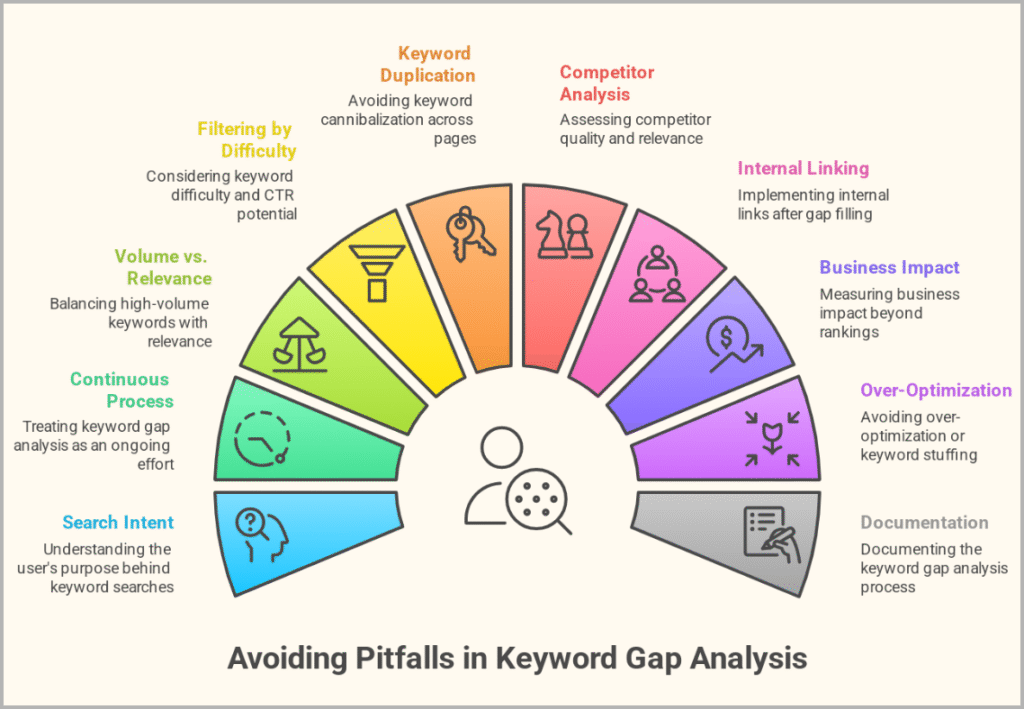
Even the best SEO strategy can underperform if the keyword gap process is executed with blind spots.
Marketers often focus so much on collecting data that they overlook context, intent, and prioritization, the very factors that determine whether gap analysis drives results or just fills spreadsheets.
Here are the most frequent mistakes (and how to avoid them) when performing a keyword gap analysis.
1. Ignoring Search Intent Behind Keywords
Many marketers identify valuable keywords but fail to analyze why users search for them.
Ranking for a term without matching intent leads to high bounce rates and poor conversions.
Avoid it by:
- Classifying every keyword as informational, commercial, or transactional.
- Reviewing top-ranking pages to understand what users expect.
- Aligning content format with intent, e.g., guides for informational queries, comparisons for commercial, and landing pages for transactional.
Example:
Targeting “best keyword gap tools” with a theoretical blog post will fail because users expect product comparisons, not definitions.
2. Treating Keyword Gap Analysis as a One-Time Project
Search behavior evolves constantly. New competitors emerge, algorithms update, and query intent shifts. Continuously update your keyword gap analysis to make a strategy.
Running a gap report once a year means you’re reacting, not leading.
Avoid it by:
- Scheduling quarterly analyses to capture new, untapped keywords.
- Setting automated alerts in Semrush or SE Ranking for ranking volatility.
- Updating your keyword map each quarter to realign priorities.
Consistent iteration transforms keyword gap analysis into a living workflow, not a static audit.
3. Overemphasizing High-Volume Keywords
It may seem appealing to target keywords with high search volumes, but these often come with strong competition and lower chances of converting visitors into customers.
Ignoring long-tail or niche keywords means missing easier, intent-driven wins.
Avoid it by:
- Balancing high-volume terms with medium-difficulty, high-intent opportunities.
- Using an opportunity scoring formula that weighs search volume against KD and intent.
- Building topic clusters that link high-volume pillars with supportive long-tails.
Winning several small queries often drives more qualified traffic than fighting over one broad term.
4. Not Filtering by Keyword Difficulty and CTR Potential
Unfiltered keyword lists quickly become overwhelming.
Without analyzing keyword difficulty (KD) or click-through potential, you risk wasting effort on terms you can’t realistically rank for.
Avoid it by:
- Filtering results to KD < 50 for new or mid-authority sites.
- Reviewing SERP features to gauge whether organic clicks are available.
- Combining volume × CTR × intent metrics to prioritize efficiently.
Remember: attainable visibility beats theoretical traffic.
5. Duplicating or Cannibalizing Keywords Across Pages
When multiple pages focus on the same or similar keywords, they compete against each other, confusing Google about which to rank.
This keyword cannibalization weakens both URLs.
Avoid it by:
- Mapping one primary keyword per page in your keyword sheet.
- Consolidating overlapping content into stronger, unified pages.
- Using internal linking instead of duplicate targeting to connect related content.
Run a quick audit in Search Console to find pages ranking for the same queries and merge where appropriate.
6. Ignoring Competitor Quality and Relevance
Choosing the wrong comparison set skews results.
Many businesses compare themselves with high-authority but unrelated domains, leading to irrelevant keyword suggestions.
Avoid it by:
- Selecting SERP-level competitors, those ranking for the same intent, not just in your industry.
- Cross-checking domain authority (DA or DR) to ensure comparability.
- Running separate analyses for direct competitors and content competitors (blogs, directories, media sites).
The right data depends on the right sources.
7. Neglecting Internal Linking After Gap Filling
You might publish new content to close keyword gaps, but without proper internal links, Google may never discover or value it.
Avoid it by:
- Adding contextual links from existing high-traffic pages to each new page.
- Using keyword-rich but natural anchor text.
- Creating reciprocal links within topic clusters to strengthen semantic relationships.
Internal linking is what transforms isolated posts into authoritative ecosystems.
8. Measuring Only Rankings, Not Business Impact
Ranking improvements are encouraging, but they don’t always equal growth.
Without tying your gap-filling efforts to measurable goals like conversions or leads, you’ll struggle to prove ROI.
Avoid it by:
- Setting up conversion tracking in GA4 for each content type.
- Linking keywords to funnel stages (informational → commercial → transactional).
- Reporting outcomes such as sign-ups, sales, or calls, not just keyword counts.
Executives value business metrics, speak their language.
9. Over-Optimizing or Stuffing New Keywords
Trying to fill every gap at once often leads to unnatural writing and declining readability.
Modern algorithms detect keyword stuffing and penalize poor user experience.
Avoid it by:
- Maintaining keyword density around 1 – 1.5 % and integrating synonyms naturally.
- Writing for readers first, search engines second.
- Using NLP tools to ensure semantic completeness instead of repetition.
Google rewards clarity, not clutter.
10. Forgetting to Document the Process
Without documentation, your keyword gap learnings vanish after each project.
New team members can’t replicate success, and future audits start from zero.
Avoid it by:
- Keeping a master sheet with columns for keyword type, KD, intent, target URL, and date added.
- Recording changes and ranking outcomes after every optimization.
- Reviewing quarterly to identify consistent success patterns.
Documentation turns experimentation into institutional SEO intelligence.
Key Takeaway
Keyword gap analysis is powerful, but precision matters more than volume. Avoiding these mistakes keeps your strategy focused, actionable, and sustainable.
When performed with intent alignment, clean data, and ongoing measurement, keyword gap analysis becomes a competitive advantage, not a recurring task.
Final Thoughts (Summary):
Keyword gap analysis is more than an SEO technique; it’s a continuous growth engine. By systematically identifying missing and weak keywords, analyzing intent, and optimizing content around them, you strengthen topical authority, increase organic visibility, and unlock consistent traffic growth.
When aligned with measurable KPIs and enhanced by semantic SEO and AI-driven insights, this process evolves into a self-sustaining system that fuels lasting competitive advantage and measurable business ROI.
Every “gap” is a signal, a roadmap showing exactly where your audience’s attention lies. Use that data to build, refine, and expand your content intelligently.
When executed continuously, keyword gap analysis becomes the engine of visibility that powers every other SEO effort, backlinking, content marketing, and brand growth alike.
So start today.
Run your first gap analysis.
Find the missing opportunities.
And turn them into your next wave of organic success.
FAQs About Keyword Gap Analysis
Q.1) What Is a Keyword Gap in SEO?
Ans: A keyword gap is the set of keywords that your competitors are ranking for but your website does not.
These “missing keywords” represent untapped opportunities to attract traffic, improve visibility, and strengthen topical authority.
Q.2) What’s the Difference Between Keyword Gap and Content Gap?
Ans: While related, they focus on different aspects of optimization:
| Aspect | Keyword Gap | Content Gap |
|---|---|---|
| Focus | Missing ranking keywords | Missing topics or subtopics |
| Data Source | SERP and competitor keyword rankings | On-page content coverage |
| Purpose | Identify ranking opportunities | Improve depth and quality of coverage |
| Example | Competitor ranks for “keyword gap tools” | You lack a tutorial explaining “how to use keyword gap tools.” |
In short:
Keyword gap analysis tells you what to target.
Content gap analysis tells you how deeply to cover it.
Both combined form a complete content optimization strategy.
Q.3) How Often Should You Perform a Keyword Gap Analysis?
Ans: For most sites, a quarterly gap analysis is ideal.
However, the frequency can change depending on your industry, like;
- Fast-moving niches (SaaS, SEO, eCommerce): monthly or bi-monthly.
- Steady niches (real estate, education, local services): every 3–4 months.
Re-run your analysis whenever:
- Competitor rankings shift noticeably.
- You publish multiple new pages.
- Search intent trends change (e.g., due to Google updates or AI Overviews).
Regular analysis ensures your content strategy remains proactive rather than reactive.
Q.4) Which Tools Are Best for Keyword Gap Analysis?
Ans: Several industry-leading SEO tools offer dedicated keyword gap features.
The best ones in 2025 include:
| Tool | Ideal For | Key Features |
|---|---|---|
| Semrush | All-purpose SEO | Compare 5 domains, classify missing/weak/shared keywords |
| Ahrefs | Technical SEOs | Content gap + backlink authority integration |
| SE Ranking | Agencies | Affordable, visual reports, multi-domain comparisons |
| SurferSEO | Content teams | NLP & topic-based content gap optimization |
| AIOSEO (WordPress) | Beginners | Built-in Semrush data inside the WordPress dashboard |
If you’re just starting, begin with a free trial from Semrush or SE Ranking and use Google Keyword Planner alongside them to understand your keyword landscape before committing to a plan.
Q.5) How Do You Perform a Keyword Gap Analysis Step by Step?
Ans: Here’s a simple workflow:
- Identify competitors’ ranking for your target keywords.
- Run their domains through a keyword gap tool.
- Analyze segments: missing, weak, shared, and untapped keywords.
- Filter by keyword difficulty, search volume, and intent.
- Prioritize opportunities using an opportunity score formula.
- Create or optimize content targeting these missing terms.
- Monitor ranking and traffic improvements in Google Search Console.
This repeatable process helps build authority topic by topic, month after month.
Q.6) Can Keyword Gap Analysis Help With AI SEO or Semantic Search?
Ans: Absolutely. In the era of AI-driven search and semantic indexing, keyword gap analysis becomes even more critical.
By combining NLP keyword extraction and topic modelling, you can:
- Identify latent semantic keywords competitors overlook.
- Understand the query relationships Google associates with your niche.
- Build content clusters that perform better in AI Overviews and contextual SERPs.
Tools like Frase, SurferSEO, or NeuronWriter now integrate NLP scoring directly into the gap analysis workflow.
Q.7) How Do You Prioritize Which Keyword Gaps to Fill First?
Ans: Not all gaps are equal. To focus efforts effectively, prioritize based on:
- Intent: Start with commercial and transactional queries that drive conversions.
- Difficulty: Target low-to-medium KD keywords first for faster results.
- Volume: Pick keywords with steady search traffic.
- Business Relevance: Focus on terms directly tied to your products or services.
You can use asimple formula:
Opportunity Score = (Search Volume × CTR Potential × Intent Weight) ÷ KD
Higher scores mean greater opportunity for impact and ROI.
Q.8) Can Keyword Gap Analysis Improve Domain Authority?
Ans: Indirectly, yes. When you consistently create content that fills keyword and content gaps:
- Your topical coverage deepens, which signals authority to Google.
- You attract organic backlinks from users citing your comprehensive guides.
- Your internal linking becomes stronger as topic clusters expand.
All these factors contribute to building perceived expertise, trustworthiness, and eventually a higher domain authority over time.
Q.9) How Long Does It Take to See Results From Keyword Gap Analysis?
Ans: Typically, you’ll start noticing ranking and traffic changes within:
- 2–4 weeks for updated content (weak keywords).
- 6–12 weeks for new pages (missing or untapped keywords).
Timeframes depend on:
- Domain authority
- Keyword competition
- Crawl frequency
- Content quality and topical fit
To accelerate results, combine gap analysis with internal linking, schema markup, and fresh backlinks.
Q.10) Is Keyword Gap Analysis Suitable for Small Websites or Beginners?
Ans: Yes, in fact, smaller sites benefit the most. For beginners, it provides a clear direction for what to write next, based on proven competitor data.
Q.11) What’s the Biggest Mistake to Avoid in Keyword Gap Analysis?
Ans: The biggest mistake is focusing on quantity instead of strategy. Always prioritize relevance, quality, and intent alignment over raw keyword volume.