
The New Era of Keyword Intelligence
Search engines have grown far smarter than their early keyword-counting days. In 2025, they read and interpret content almost like humans, due to Natural Language Processing (NLP) and AI-driven algorithms.
If you’re still focusing only on high-volume phrases, you’re missing what really drives visibility now: NLP keywords. ”These contextual terms teach Google what your content truly means and which intent it satisfies.
In this guide, you’ll learn:
- What are NLP keywords and why they’re reshaping SEO.
- How to find NLP keywords through AI and machine learning.
- Step-by-step methods to research and apply them.
- Tools like Search Atlas, Frase.io, NeuronWriter, PageOptimizer Pro, and SurferSEO can help.
By the end, you’ll be able to find the advanced NLP techniques to improve topical authority, search relevance, and long-term rankings.
Understanding NLP Keywords: Exploring Algorithms and Techniques Behind Them
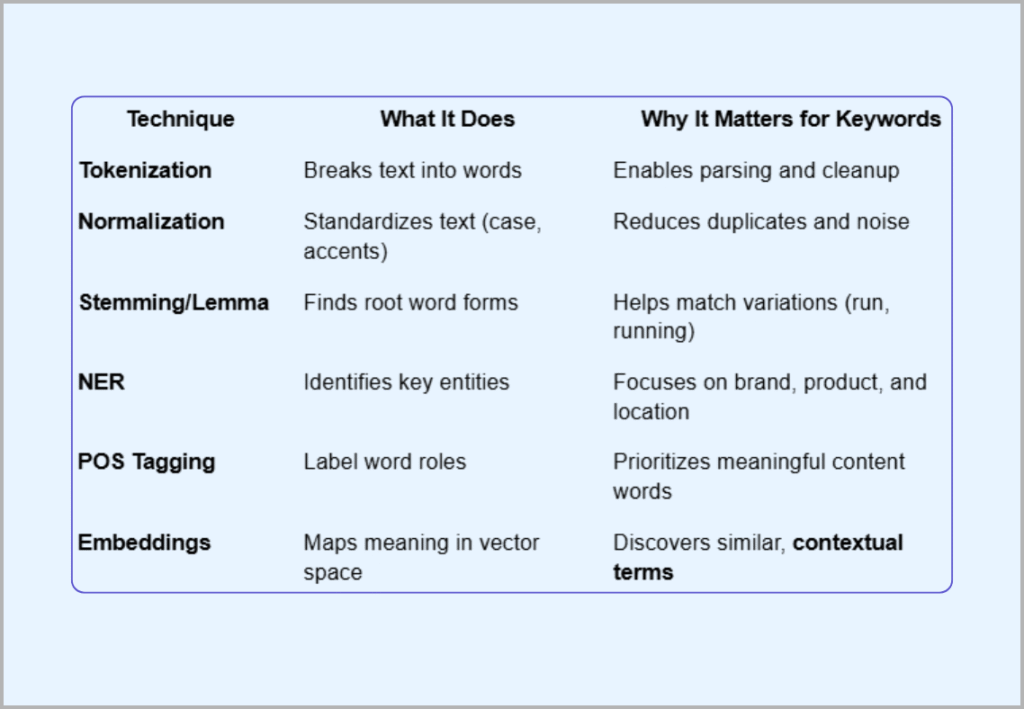
Definition, Core Concept, and NLP Tasks in Keyword Understanding
At its simplest, NLP keywords are context-aware words or phrases that AI systems, including Google’s search algorithms, recognize as semantically related to a topic.
They play a key role in modern search optimization, helping machines interpret meaning within unstructured text.
Unlike traditional keywords, which rely solely on repetition, NLP keywords capture meaning, relationships, and user intent.
They allow search engines like Google to understand human language to connect your structured content with what people actually mean when they search.
Example:
When someone searches “best SEO tools for beginners”, Google doesn’t just look for that exact phrase.
It scans for semantically related concepts such as keyword research software, on-page optimization, content audit, backlink analysis, and even an AI SEO assistant.
These co-occurring terms tell the algorithm, “This page covers the topic comprehensively.”
That’s NLP in action, reading the language of meaning, not just the language of words.
How NLP Keywords Differ from Traditional Keywords and Long-Tail Keywords
| Traditional Keyword Research | NLP-Based Keyword Research |
|---|---|
| Focuses on search volume and exact-match phrases | Focuses on context, intent, and semantic relationships |
| Works mainly with one keyword per topic | Works with clusters of related keywords |
| Ignores how people naturally phrase queries | Embraces real-language and question-based terms |
| Optimizes density | Optimizes relevance |
Traditional keyword targeting is like throwing darts in the dark. NLP keywords give you night vision, helping search engines understand how each piece of content fits within an entire conversation happening online.
Use words and phrases such as semantic keywords, latent semantic keywords, topic modelling, and contextually relevant phrases in your strategy to build depth, not redundancy.
These represent modern best practices in SEO content development.
How Natural Language Processing Algorithms Improve SEO Strategies in 2025
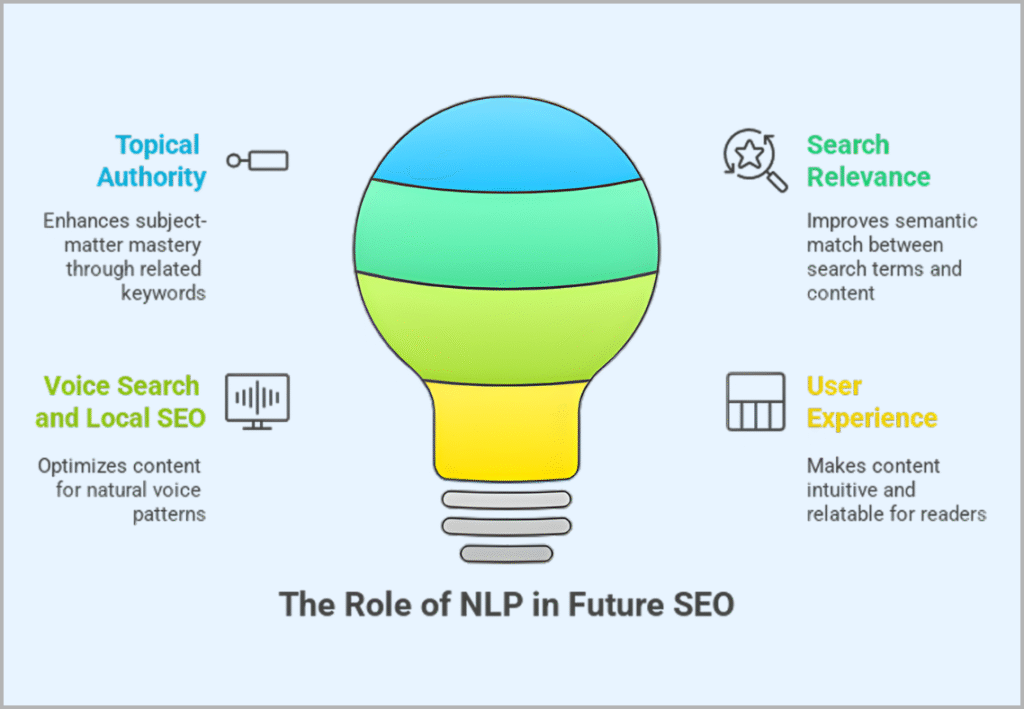
Search algorithms powered by AI, machine learning, and large language models (LLMs) now rely on NLP tasks and natural language understanding to interpret intent and context.
Here’s why incorporating NLP keywords matters more than ever:
- They enhance topical authority.
Covering semantically related and long tail keywords shows subject-matter mastery. - They improve search relevance.
Google’s BERT, MUM, and Gemini models evaluate the semantic match between a search term and your content. - They align with voice search and local SEO.
NLP keywords help capture those natural patterns through word segmentation and matching word analysis. It’s crucial for optimizing content for voice search and conversational queries. - They strengthen user experience.
Readers find your article intuitive because it uses the same language they do.
In short, NLP keywords bridge AI comprehension and human expression, the sweet spot where modern SEO wins.
As NLP keeps changing SEO in 2025, it’s essential to know how keyword extraction works and how it helps to improve your content.
How NLP Keyword Extraction Works: Inside the Algorithm, Deep Learning, and Language Model Process
NLP keyword extraction is the process of identifying the most meaningful terms within a text using computational linguistics.
It’s all about using smart extraction techniques and common NLP algorithms to extract keywords efficiently from unstructured text.
NLP keyword extraction doesn’t just stop at finding relevant terms; it also works alongside sentiment analysis to understand the tone and emotional context of the text.
These methods also support text classification, helping NLP systems organize content by topic, tone, and intent for more accurate keyword insights.
This section explains how machines do what seasoned SEOs now replicate manually with advanced tools, showing how to leverage NLP to make better data-driven decisions and enhance search optimization.
Step-by-Step Keyword Extraction Workflow
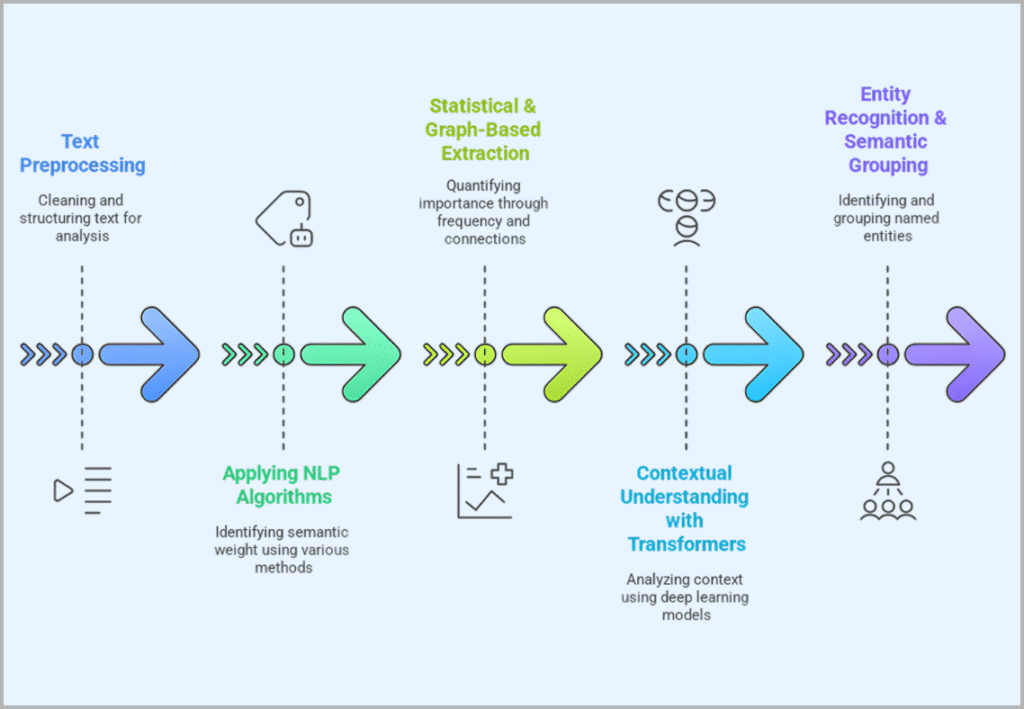
Step 1: Text Preprocessing
Before extraction begins, text is cleaned and structured, a critical Python NLP and text based classification foundation step.
- Tokenization: Splitting text into individual words or compound words for analysis.
- Removing stop words: Eliminating “the”, “is”, “and”, words with no meaning weight.
- Stemming / Lemmatization: Converting different word forms like ‘running’ → ‘run’.
- Sentence Segmentation: Identifying complete thought units.
These steps ensure the algorithm understands how each word contributes to the meaning of the entire document, not just isolated sentences, forming a clean foundation for any keyword extraction algorithm to work effectively.
Step 2: Applying NLP Algorithms
Once preprocessed, algorithms identify which words or phrases carry semantic weight.
Common keyword extraction methods and NLP uses include:
- RAKE (Rapid Automatic Keyword Extraction): Finds frequent multi-word phrases.
- YAKE (Yet Another Keyword Extractor): Weights words by statistical importance.
- TextRank Algorithm: Builds a word relationship graph similar to PageRank.
- KeyBERT Model: Uses transformer embeddings to find relevant words and contextual meaning.
- spaCy Keyword Extraction: Relies on linguistic rules, noun detection, and part-of-speech tagging.
Each method represents a different use case, from simple frequency-based systems to AI-powered SEO algorithms capable of understanding contextual meaning and information from text.
Step 3: Statistical & Graph-Based Extraction
Algorithms like TF-IDF (Term Frequency–Inverse Document Frequency) and TextRank quantify importance by evaluating how often terms appear relative to their rarity.
Graph-based methods map connections between matching words, signaling stronger topic associations and semantic density.
Step 4: Contextual Understanding with Transformers
Modern systems use deep learning and transformer models (BERT, GPT, Gemini) to read context the way humans do.
They analyze word co-occurrence, sentence structure, and semantic similarity, producing remarkably accurate keyword lists through NLP tasks that improve search optimization and support every seo support.
Step 5: Entity Recognition & Semantic Grouping
Finally, NLP performs entity extraction to identify named entities (brands, tools, people) and group them by meaning.
Example: Frase.io, NeuronWriter, and SurferSEO belong to one semantic group, AI SEO tools.
This automated clustering mirrors how Google’s Knowledge Graph organizes information from text, helping SEOs build deeper topical connections and identify valuable use cases for optimization.
Supervised vs Unsupervised Keyword Extraction
| Type | Description | Example Algorithms |
|---|---|---|
| Unsupervised | No labeled data; relies on statistical patterns. | TF-IDF, TextRank, RAKE, YAKE |
| Supervised | Learns from examples; uses machine learning models trained on labeled keyword sets. | Naïve Bayes Classifiers, Support Vector Machines, Transformer Models |
In SEO applications, most AI tools combine both approaches: an unsupervised phase to discover long-tail keywords and a supervised phase to rank them by contextual relevance and search optimization value.
Connecting NLP Extraction to SEO Content
When you use an AI SEO tool such as Frase.io or Search Atlas, you’re indirectly conducting competitor analysis through NLP extraction.
They extract terms from top-ranking pages, identify semantic patterns, and then recommend keywords that strengthen your own content’s relevance.
In essence, they reverse-engineer Google’s understanding of a topic and hand it to you in an actionable format.
Understanding how NLP keyword extraction works is just the first step; the real power comes when marketers leverage these NLP uses and AI tools to drive smarter search optimization.
How Marketers Can Leverage Generative AI and NLP Tools for Smarter Search Optimization
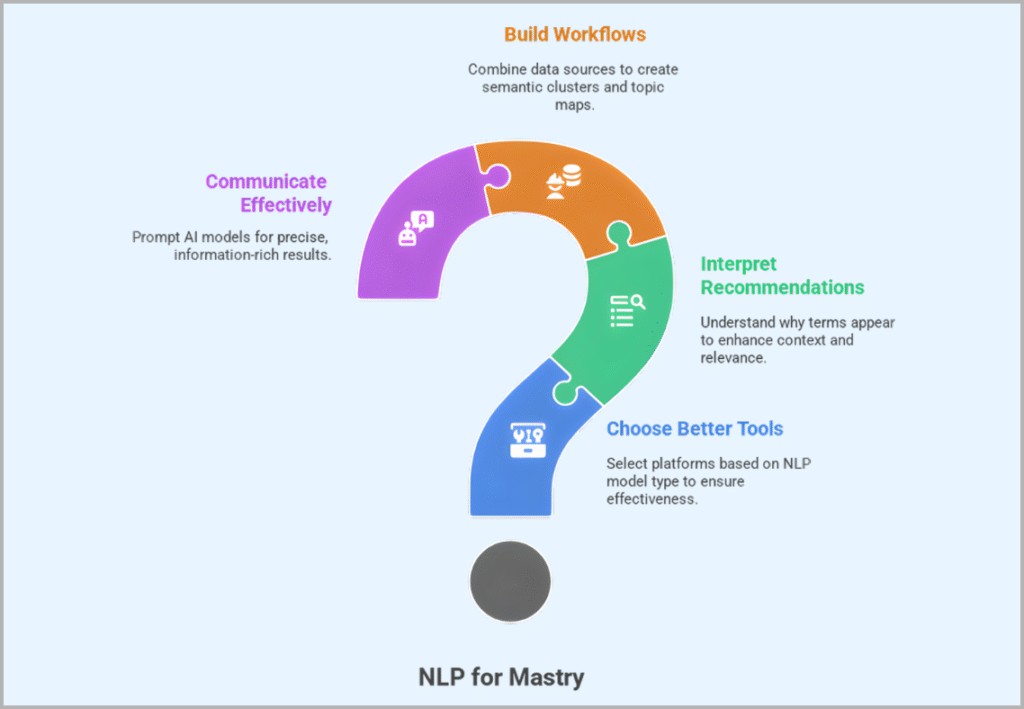
Many SEO professionals overlook how these NLP algorithms operate. Understanding these fundamentals helps you think the way search engines use NLP for context and ranking.
- Choose better tools.
Know whether a platform uses transformer models, Python NLP, or older statistical methods. - Interpret recommendations accurately.
Recognize why certain terms appear. NLP models detect word sense differences that affect meaning, identifying the matching words that connect context and relevance. - Build your own workflows.
Combine Google Keyword Planner data with NLP keyword extraction to form semantic clusters and text classification-based topic maps. - Communicate with AI content tools effectively.
Prompt models with “Extract NLP keywords from this topic” to get more precise, information-rich results.
Understanding NLP keywords isn’t about becoming a coder; it’s about using AI systems that process human language to think like a search engine while writing for humans.
Once you understand how to leverage NLP uses and AI tools for smarter search optimization, the next step is learning the practical process of finding NLP keywords that truly boost your SEO and content performance.
Practical Process: How to Find NLP Keywords for SEO and Content
In this section, we’ll move from theory to action. You’ll learn exactly how to discover, organize, and validate NLP keywords that build topical authority and align with search intent.
Each step is written in Syscality’s structured, bullet-point format for clarity and immediate application.
How to Find NLP Keywords Step by Step: Best Practices and NLP Techniques for SEO
Step 1: Start with Seed Keywords and Topic Analysis
Before any algorithm comes into play, you need a clear topic foundation.
• Define your content goal.
Is it informational (educate), commercial (convert), or mixed? Your intent determines which NLP clusters to prioritize.
• Collect seed keywords.
Use base terms that represent your niche. Example: AI SEO, semantic search, keyword extraction, and content optimisation.
• Research context, not just volume.
Plug these seeds into Google’s “related searches,” People Also Ask boxes, and autocomplete suggestions. Each variation hints at an intent cluster.
• Map early clusters.
Group by meaning: e.g., NLP keyword extraction, entity recognition, and semantic clustering all fit under “AI SEO keyword discovery.”
Pro Tip: Track search optimization columns like Primary Keyword, Semantic Cluster, Intent, Search Volume, and Notes for better SEO effort management.
Step 2: Use Artificial Intelligence and NLP Tools to Expand Your List
Now, use AI-powered SEO tools to scale keyword discovery. Here is where NLP technology multiplies your insight.
Recommended tools (authoritative & affiliate-safe):
| Tool | Primary Use | Strength |
|---|---|---|
| Search Atlas | NLP-driven content mapping | Identifies semantic relationships and keyword entities directly from top-ranking pages. |
| Frase.io | Content briefs & topic models | Extracts NLP keywords, questions, and subtopics for content outlines. |
| NeuronWriter | AI SEO writing & clustering | Shows semantic relevance scores and contextual density. |
| PageOptimizer Pro | On-page SEO using NLP analysis | Audits your content against Google NLP API terms. |
| SurferSEO | Content Editor with LSI and NLP metrics | Visualizes term frequency, sentiment, and topic depth. |
Workflow using these tools:
- Input your seed keywords into each platform.
- Export the suggested NLP keywords, entities, and phrases.
- Cross-compare lists; overlapping terms are usually the strongest semantic signals.
- Tag each by intent: Informational, Commercial, Navigational, Transactional.
This step ensures you’re not guessing what Google values; you’re extracting it directly from SERP-verified data.
Step 3: Analyze User Intent and Semantic Relevance
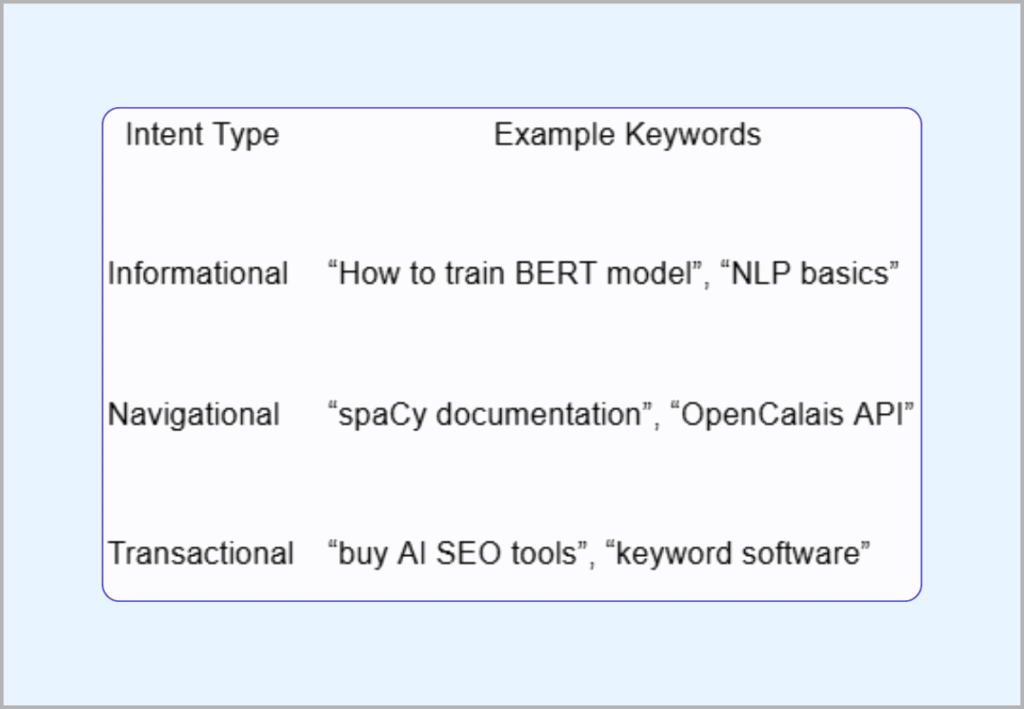
Modern SEO succeeds when search intent and natural language understanding align.
• Understand the four core intents:
- Informational: users want knowledge.
- Navigational: they seek a brand or site.
- Commercial Investigation: comparing options.
- Transactional: ready to act or buy.
• Evaluate which intent dominates your topic.
For example, “what are NLP keywords” is informational; “best NLP keyword tool 2025” is commercial.
• Align each NLP keyword to intent.
Use NLP tools’ “context relevance” or “SERP intent” columns to confirm.
• Filter irrelevant matching words.
Drop terms that are lexically similar but semantically off-topic (e.g., “NLP therapy” vs. “NLP in SEO”).
When clusters match use cases and intent, your SEO content performs better naturally.
Step 4: Cluster and Organize Your Keywords
Keyword clustering converts long lists into strategic topic groups.
• Group by semantic similarity.
Use algorithms or AI tools to auto-cluster by meaning, not just phrase match.
• Structure clusters by hierarchy:
- Pillar Topic: “NLP Keywords”
- Cluster 1: “Keyword Extraction Methods in NLP”
- Cluster 2: “AI SEO and Content Optimisation”
- Cluster 3: “Best NLP Keyword Tools 2025”
• Assign one page per cluster.
This prevents cannibalization and signals depth to Google.
• Use internal links strategically.
Each cluster should link to its pillar page using descriptive anchor text (e.g., semantic keyword extraction → main guide).
Pro Tip: SurferSEO and NeuronWriter both visualize cluster relationships, helping plan content architecture.
Step 5: Validate and Prioritize Using Data
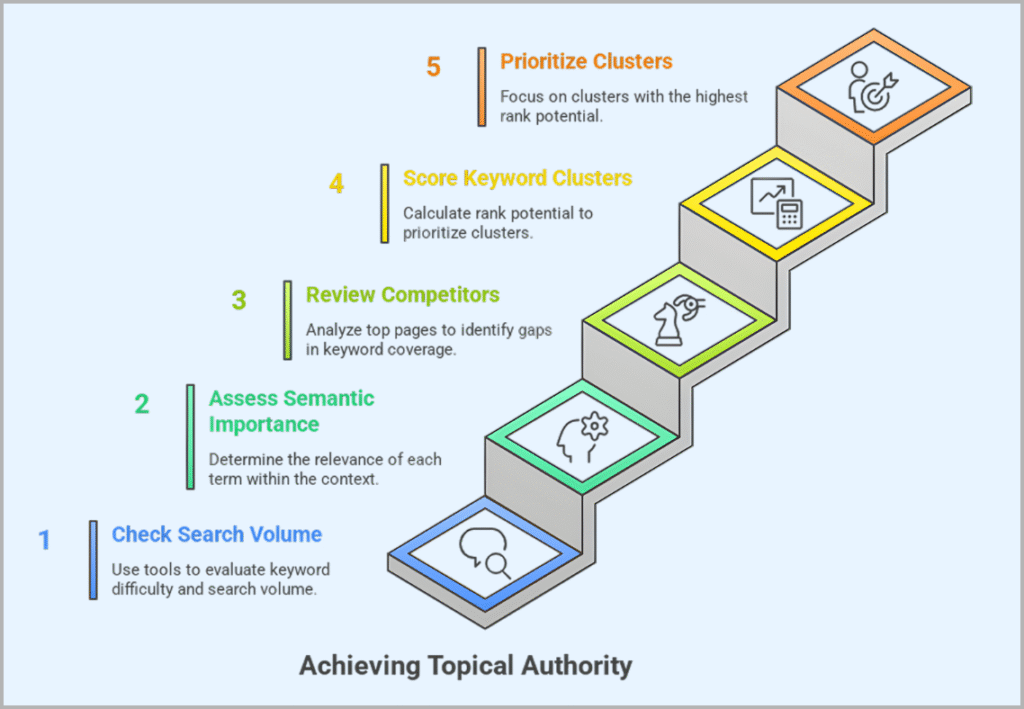
Once you’ve built clusters, confirm which ones deserve focus.
• Check search volume and difficulty.
Use Semrush or Search Atlas to evaluate Keyword Difficulty (KD), Volume, and SERP competition.
• Assess semantic importance.
In NeuronWriter, note each term’s Relevance Score; higher scores indicate stronger contextual alignment.
• Review competitors.
Analyze top pages’ NLP keyword density and entity coverage. Look for gaps you can fill.
• Score each keyword cluster:
Rank Potential = (Search Volume × Relevance Score) / Keyword Difficulty
Prioritize the clusters with the highest Rank Potential for faster topical authority gains.
Practical Example: Building an NLP Keyword Map
Let’s illustrate how this works for a sample topic: AI SEO Tools 2025.
- Seed keywords: AI SEO, semantic optimization, keyword extraction, NLP
- Extracted NLP terms (via Frase): “topic clusters,” “language model,” “content optimization,” “search intent,” “semantic relationships.”
- Cluster grouping
- Algorithm & AI core: language model, machine learning, transformer model
- SEO application: semantic search, keyword clustering, topic modeling
- Tool ecosystem: Frase.io, SurferSEO, PageOptimizer Pro, NeuronWriter
4. Content mapping:
- Pillar Page → “How AI SEO Tools Use NLP for Keyword Optimization”
- Cluster Articles → “Keyword Clustering in NLP,” “Entity Recognition for SEO,” “Best AI SEO Tools 2025.”
This blueprint turns abstract keyword lists into an actionable content strategy aligned with both algorithmic understanding and reader needs.
Integrating NLP Keywords, Voice Search, and Structured Content into SEO
Finding keywords is only half the job; placement defines results.
Where to Use NLP Keywords Naturally
- Title Tag & Meta Description: include the core NLP phrase once.
- Introduction & H1: state the topic clearly to anchor the context.
- H2/H3 Subheadings: distribute semantic keywords to signal depth.
- Body Text: Weave in secondary terms like semantic search or entity recognition within examples.
- Image Alt Text & Captions: Reinforce topic relevance subtly.
- Conclusion: restate the main keyword with an action-driven insight.
Avoid mechanical repetition; vary phrasing using synonyms or long-tail versions.
Semantic Density and Readability
- Maintain a keyword presence of 1.2–1.8% per 1,000 words.
- Emphasize semantic variety over density.
- Ensure sentence flow mirrors human language; this directly improves NLP scoring in content analyzers like SurferSEO.
Evaluating Your NLP Keyword Performance
After publishing, monitor metrics that reveal real success.
• Track ranking improvements for both main and semantic keywords using Search Atlas or Semrush.
• Observe Google Search Console impressions vs clicks for entity-related queries.
• Measure engagement metrics (time on page, scroll depth, CTR).
• Refine content periodically as AI algorithms evolve; update with emerging entities or queries.
Consistent evaluation transforms static optimization into a living semantic SEO system.
Top NLP Keyword Research Tools (2025 Edition)
In 2025, the competition isn’t about finding keywords; it’s about understanding them.
The following tools combine AI, semantic analysis, and NLP keyword extraction to help SEOs uncover hidden ranking opportunities and strengthen content relevance.
1. Search Atlas: Advanced NLP Keyword Mapping
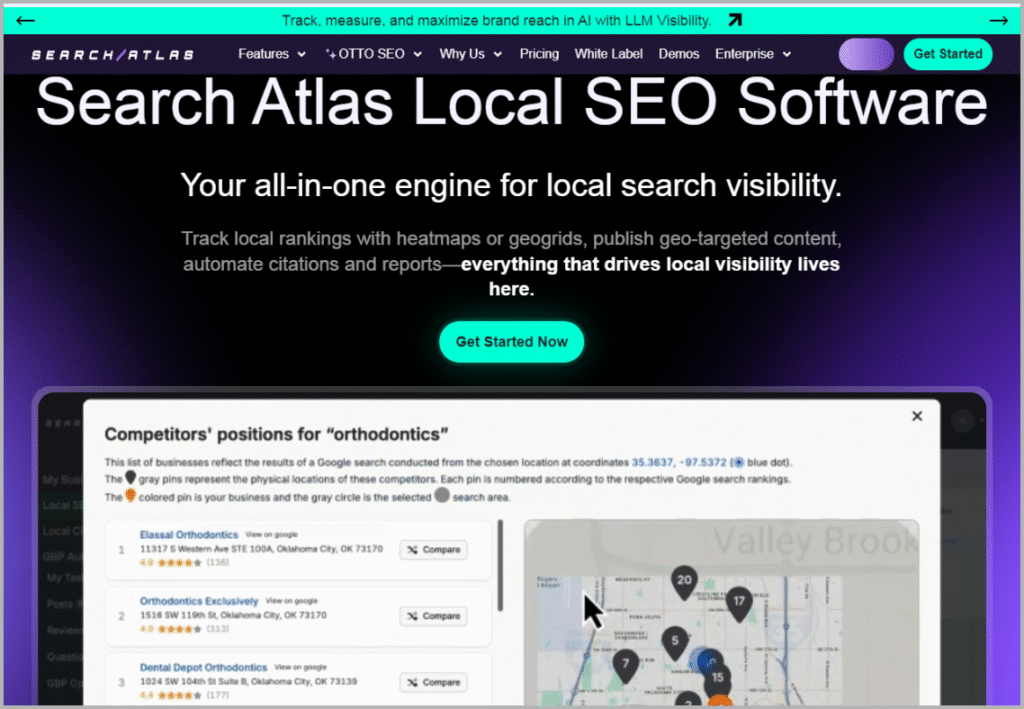
Best For: NLP-based keyword extraction and content strategy planning.
Key Features:
- Uses semantic entity recognition to extract related keywords from top-ranking pages.
- Provides keyword clustering and intent mapping directly from SERP data.
- Offers a content optimizer that aligns your writing with Google NLP API patterns.
Why It Stands Out:
Search Atlas bridges NLP and SEO perfectly, identifying contextually relevant keywords and topic clusters faster than manual research.
For marketers who prioritize depth and topical authority, this tool sets the benchmark.
2. Frase.io: AI-Powered Topic & NLP Brief Builder

Best For: Creating AI content briefs and identifying NLP keyword gaps.
Key Features:
- Extracts NLP keywords and People Also Ask questions from top results.
- Displays semantic term frequency and entity context.
- Automatically creates SEO-structured briefs using NLP data.
Why It Stands Out:
Frase.io is ideal for scaling content teams. It helps writers embed NLP keywords naturally, ensuring every blog post aligns with semantic search and user intent.
3. NeuronWriter: Semantic Keyword Optimization for Writers

Best For: Content creators who want guided, NLP-informed writing.
Key Features:
- Integrates Google NLP API for entity detection and semantic analysis.
- Suggests semantic keyword clusters in real time.
- Ranks your content by semantic relevance score.
Why It Stands Out:
NeuronWriter excels at balancing readability with optimization. Its content scoring system ensures you maintain human flow while still satisfying algorithmic precision.
4. PageOptimizer Pro: On-Page SEO with NLP Integration
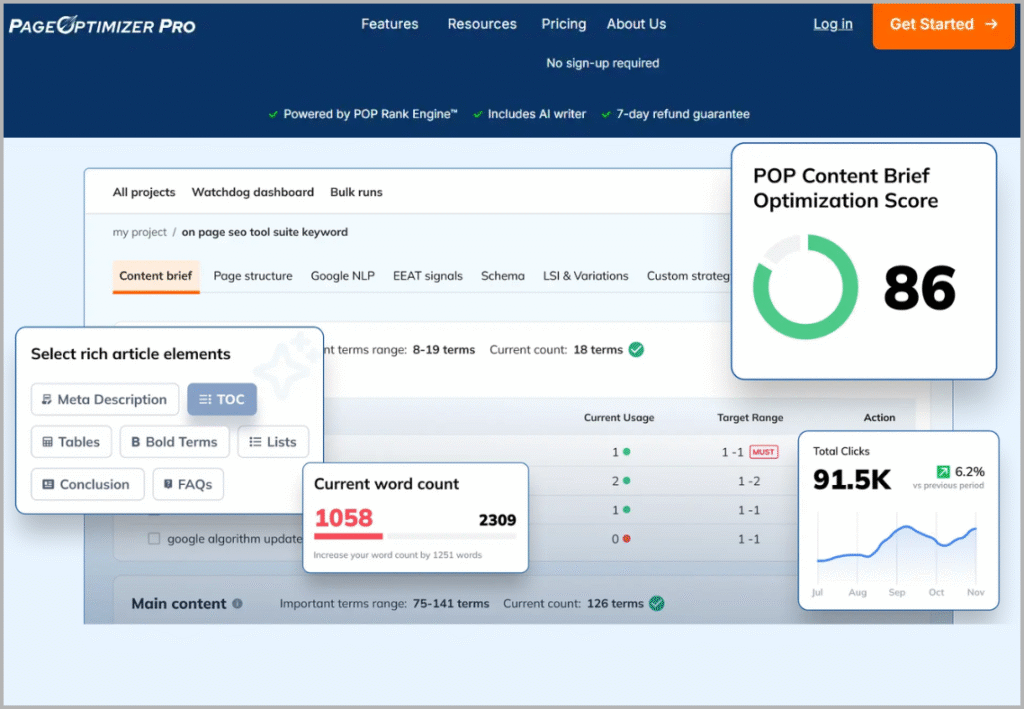
Best For: Technical SEOs seeking detailed page-level NLP audits.
Key Features:
- Compares your page to competitors using Google’s NLP API.
- Identifies entities, topics, and keyword gaps.
- Provides exact word frequency and placement recommendations.
Why It Stands Out:
PageOptimizer Pro is built for professionals who demand precision. It explains why certain NLP terms matter, not just what to use.
5. SurferSEO: Visual NLP-Driven Content Editor

Best For: Visual optimization and real-time NLP keyword tracking.
Key Features:
- NLP term detection using AI and BERT-based algorithms.
- Suggests keywords for paragraphs, headings, and meta tags.
- Measures content score based on NLP keyword integration and readability.
Why It Stands Out:
SurferSEO’s Content Editor blends simplicity with intelligence, showing you exactly how well your article aligns with Google’s semantic expectations.
Now that you know which tools to use, let’s look at how to apply them effectively in your SEO content strategy to drive real search performance.
Using NLP Keywords in Your SEO Content Strategy
Once you’ve gathered your NLP keywords, the next challenge is strategic placement. The goal isn’t keyword stuffing, it’s semantic reinforcement.
Integrate NLP Keywords Across Key Content Areas
- Page Title & H1: Include your main NLP phrase naturally.
- Subheadings (H2/H3): Add contextual variants and related entities.
- Body Copy: Blend semantic keywords into explanations and examples.
- Anchor Texts: Use NLP-driven anchors when linking to related pages.
- Alt Text & Captions: Subtly reinforce main concepts like semantic search or entity recognition.
- FAQs: Use long-tail NLP keyword questions for schema markup.
Example:
Instead of “Best tools for keyword extraction,” write “Best NLP keyword extraction tools for SEO content strategy.”
This phrasing naturally covers multiple semantic layers: best, NLP, keyword extraction, SEO, and content strategy.
Build Content Around Intent Clusters
Align every content cluster to a distinct search intent.
- Informational pages → definitions, comparisons, educational depth.
- Commercial pages → tools, pricing, benefits, case studies.
- Transactional pages → signup links, free trials, affiliate CTAs.
When each page clearly serves one intent, search engines can map your entire site’s topical relevance.
Reinforce Internal Linking with NLP Context
Use NLP keywords to strengthen topical silos:
- Link “semantic keyword extraction methods” → “how NLP works in SEO.”
- Link “AI SEO content optimization” → “Frase.io review for content strategy.”
This builds an interconnected structure that Google reads as authority flow, improving both indexation and trust.
Once you start using these tools in your SEO content strategy, be cautious; many marketers misuse them by chasing keyword volume instead of context, which weakens search relevance and topical depth.
Now it’s crucial to understand the common mistakes marketers make when applying them, so you can avoid wasting effort and get better results.
Common Mistakes to Avoid in NLP Keyword Research
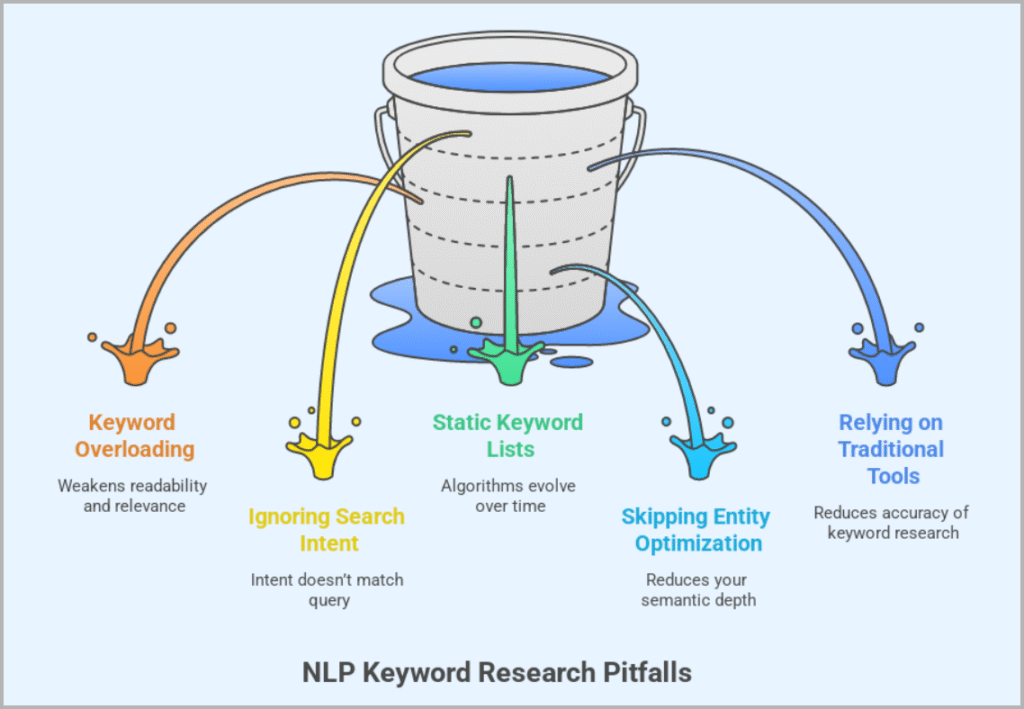
Even advanced SEOs often misuse NLP keyword data. Avoid these pitfalls:
• Mistake 1: Overloading with raw keywords
NLP is about context, not count. Repeating every related term weakens readability and relevance.
• Mistake 2: Ignoring search intent alignment
A semantically perfect article won’t rank if the intent doesn’t match the query type.
• Mistake 3: Treating NLP outputs as static lists
Algorithms evolve. Update your NLP keyword sets quarterly to reflect AI and SERP shifts.
• Mistake 4: Skipping entity-level optimization
Entity recognition (tools, brands, locations) signals authority. Neglecting it reduces your semantic depth.
• Mistake 5: Relying only on traditional keyword tools
Keyword Planner and Ahrefs still matter, but pairing them with NLP-driven systems multiplies accuracy.
Real-World Examples & Case Studies: How SEOs Leverage NLP Algorithms for Keyword Discovery
Example 1: Using Frase.io for SEO Blog Optimization
- Topic: “AI SEO Strategies 2025”
- Extracted NLP keywords: semantic analysis, user intent, topic clusters, generative AI, and keyword discovery.
- Result: Increased organic visibility by 38% in 60 days due to improved topical coverage.
Example 2: Search Atlas Entity Mapping
- Campaign: Content Authority for SaaS blogs.
- Used Search Atlas to identify missing entities and semantic gaps across pillar pages.
- Result: +40% improvement in topical authority within two months.
Example 3: SurferSEO Content Score Upgrade
- Old article: Keyword Research Basics (Score 57)
- After NLP keyword integration (using SurferSEO): Score 89
- Ranking improved from page 3 → position 7 in 3 weeks.
Each of these demonstrates that NLP isn’t just theoretical; it produces measurable SEO outcomes.
Conclusion: The Future of Keyword Research and Local SEO (2025 & Beyond): Applying Core NLP and AI Tools
SEO is no longer about guessing what Google wants; it’s about understanding how it reads.
NLP keywords represent this shift. They allow creators and marketers to connect language, meaning, and intent in a way that algorithms respect and users enjoy.
To master 2025 SEO:
- Think semantically, not syntactically.
- Use AI tools that decode search intent.
- Continuously refine your keyword maps with NLP-driven data.
By combining NLP techniques, AI tools, and smart keyword strategies, you can transform raw data into meaningful insights.
The more you align with how Google interprets content, the more your pages will rise, naturally, sustainably, and with true authority.
FAQs About NLP Keywords
Q.1) What are NLP keywords in SEO?
Ans: NLP keywords are context-aware terms that search engines interpret as semantically related to your topic. They go beyond exact matches to reflect meaning and user intent.
Q.2) How do I find NLP keywords for my content?
Ans: Use NLP-based tools like Search Atlas, Frase.io, or NeuronWriter. These extract semantically relevant terms, questions, and entities directly from high-ranking pages.
Q.3) What is the difference between NLP keyword extraction and traditional keyword research?
Ans: Traditional research focuses on volume and competition, while NLP keyword extraction focuses on context, relationships, and meaning.
Q.4) How do NLP keywords improve SEO performance?
Ans: They enhance topical authority, help Google understand your content’s subject, and align it with voice and semantic search algorithms.
Q.5) Are NLP keyword tools expensive?
Ans: Most offer free plans or trials. Paid versions provide advanced features like entity analysis, topic clustering, and real-time optimization.