
A keyword strategy is the process that goes beyond research, it’s the deliberate plan to capture search visibility and drive measurable revenue.
Keyword Research Vs. Keyword Strategy

Keyword research gathers data such as search volume, keyword difficulty & SERP competition.
A keyword strategy is a plan that transforms data into an actionable roadmap, deciding which target keywords to focus on, how to group them, and how to apply keyword matching to the type of content to create related to search queries.
How Good Keyword Strategy Aligns with Business Goals
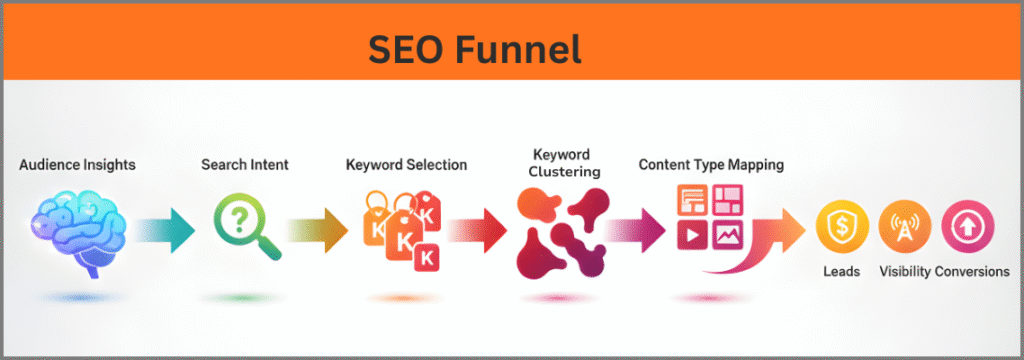
A good keyword strategy aligns with business goals by targeting search terms that match what your ideal customers are actively looking for.
Instead of chasing random keywords, it focuses on high-intent queries that drive qualified traffic, improve conversions, and support specific objectives, whether that’s generating leads, boosting product sales, or building brand visibility.
By mapping keywords to the buyer journey and prioritizing terms based on relevance, keyword difficulty, and revenue potential, your SEO efforts directly contribute to measurable business growth.
Why It Matters
- It saves time by focusing on keyword opportunities where you have a real chance of ranking.
- It boosts organic traffic that actually supports conversions.
- It gives clarity to writers and marketers across campaigns, helping them build a successful SEO plan.
Example: A business publishing random blog posts about “Digital Marketing” might see impressions but little revenue.
A company applying a keyword strategy for SEO – targeting long-tail, intent-driven phrases can achieve consistent visibility and measurable ROI.
Understanding the Keyword Planning Process
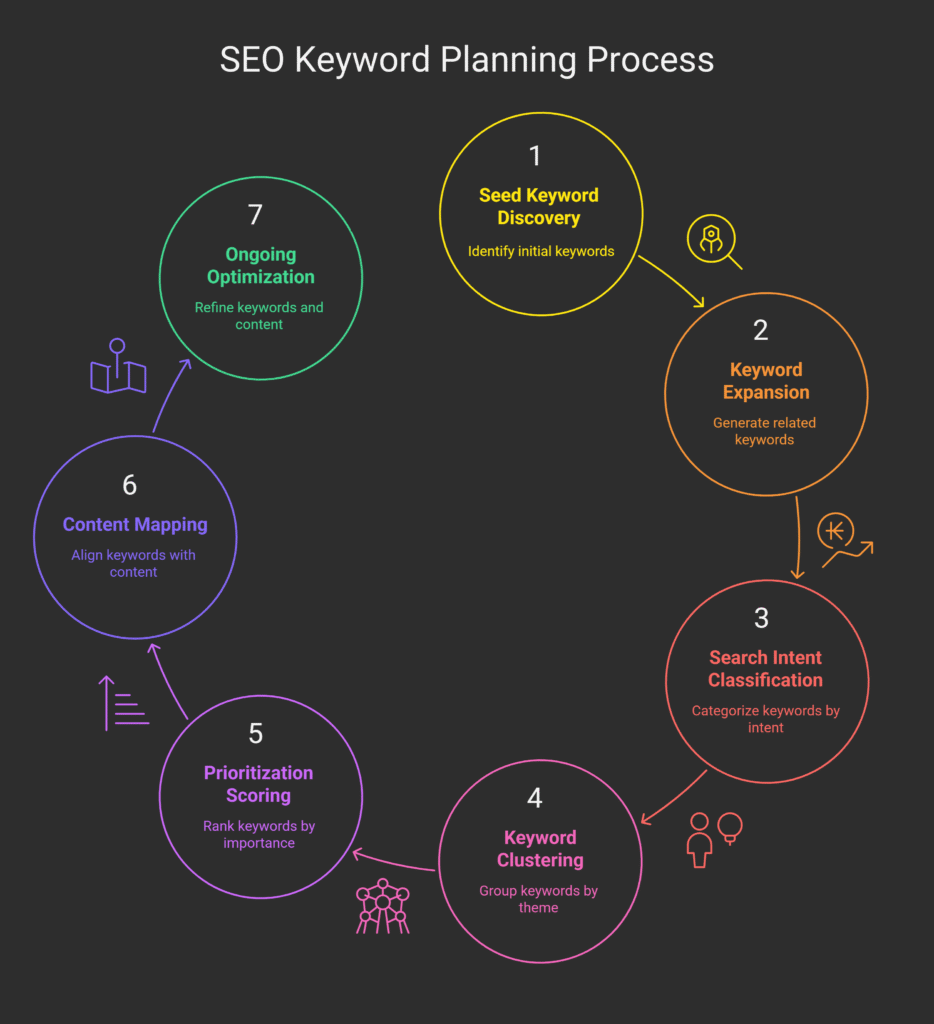
Creating a solid keyword strategy begins with a defined planning process, here’s how to build one:
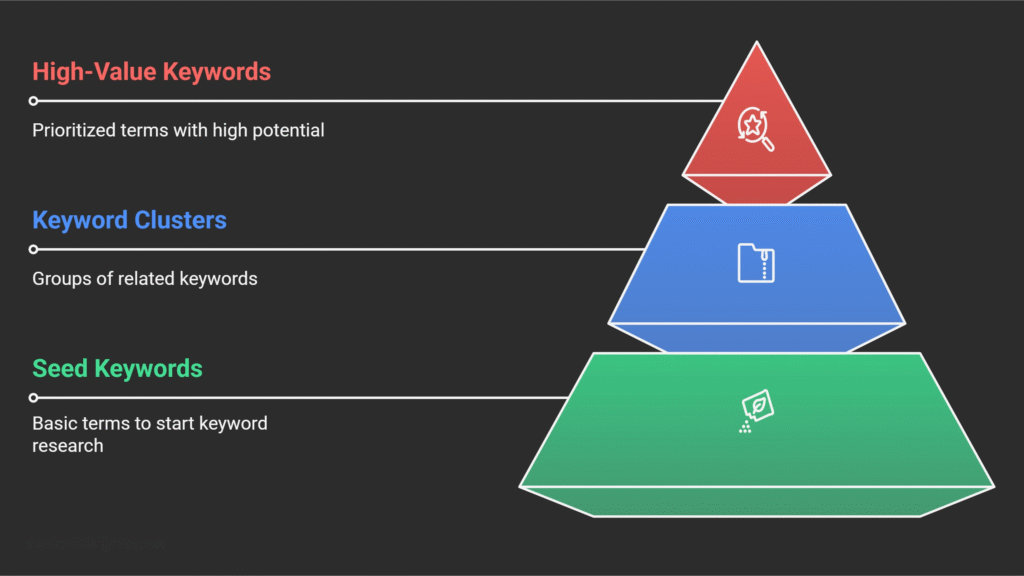
1. Discovery: Gather Seed Keywords for Your SEO Keyword Strategy
Collect seed keywords from your products, competitors, and customer language.
This list of keywords becomes the foundation for exploration and helps you find keywords that align with real search intent.
2. Expansion – Generate Keyword Ideas
Expand your list of relevant keywords using keyword research tools like
- Google Keyword Planner
- Semrush Keyword Magic Tool
- Ahrefs Keywords Explorer
Focus on related terms, synonyms, and long-tail keywords with higher specificity variations.
3. Classification – Understanding Keyword Intent and User Search Behavior
Apply search intent classification, informational, navigational, commercial, transactional to achieve these keyword goals.
4. Clustering – Group by Topic and Organize Target Keywords
Use keyword clustering strategy or simple spreadsheets to bundle similar phrases. Each cluster represents one topic or page.
5. Prioritization – Choose Keywords Based on Keyword Difficulty and Value
Evaluate keyword difficulty, ranking potential, and business fit to decide what to targeting that keyword first.
6. Mapping – Assign Target Keywords to the Right Pages
Connect clusters to type of content such as blog posts, product pages, or landing pages.
7. Optimization and Tracking: Refine and Improve Your Keyword Strategy Over Time
Publish optimized pages and monitor with Google Search Console and Google Analytics to track keyword rankings and growth.
Keyword Hierarchy & Roadmap Table
| Level | Description | Example |
|---|---|---|
| Primary Keyword | Main target phrase | keyword strategy |
| Secondary Keywords | Close variants and synonyms | SEO keyword strategy, build a keyword strategy |
| Supporting Keywords | Related concepts that strengthen topical relevance | search intent, keyword difficulty, ranking potential |
| Long-Tail Keywords | High-intent, specific keyword phrases | how to create a keyword strategy for small business |
A documented keyword roadmap ensures every page targets a clear term while contributing to overall topic authority.
Ultimate guide to Create a Effective Keyword Strategy (Step-by-Step)
Learn how to find the right keywords, analyze intent and difficulty, and build a clear SEO plan that boosts rankings and drives consistent organic traffic.
Step 1: Identify Your Business Goals and Target Audience
Every great keyword strategy process starts with clarity about why you’re ranking.
Identifying the Best Keywords that align with your business goals:
- For brand awareness, target informational topics such as “what is a digital marketing”
- For lead generation, emphasize commercial intent keywords like “digital marketing consultant”
- For sales, focus on transactional terms that reveal purchase intent “digital marketing services”
Clearly defining your target audience and aligning your SEO effort ensures every page supports your growth goals and helps you build a successful keyword strategy from the ground up.
Define Your Target Audience
- Identify potential customers, their problems, and the search phrases they use.
- Use audience research, surveys, and analytics to find recurring search terms tied to your offer.
Find Buyer-Intent Keywords
Look for modifiers that indicate readiness to buy or compare, e.g., best, vs, pricing, software, or services.
These buyer-intent keywords are essential for prioritizing ROI.
Pro Tip: Map every target keyword to both a funnel stage and a goal metric (awareness, engagement, or conversion). This transforms specific search keyword selection into business forecasting.
Step 2 – Conduct Keyword Research the Smart Way
Keyword research provides the data foundation, but a keyword strategy gives it direction.
To build a right keyword plan that delivers results, you need both quantitative data and qualitative understanding.
Differentiate Research from Strategy
- Research = Discovering opportunities.
- Strategy = Choosing the best ones to pursue based on value, competition, and intent.
Without strategy, you’ll gather thousands of keywords but lack a framework for action.
Using Keyword Research Tools for Identifying Keywords and Measuring Performance
To build a meaningful keyword list, combine several tools for a 360° view of opportunities:
| Tool | Primary Use | Why It’s Useful |
|---|---|---|
| Google Keyword Planner | Search volume and CPC | Establishes demand and intent. |
| Semrush | Keyword gaps and difficulty | Reveals competitor terms and ranking trends. |
| Ahrefs | SERP and backlink context | Helps estimate chance of ranking. |
| Frase.io | SERP brief generation | Useful for mapping type of content needed. |
| Search Atlas | Topic clustering and semantic mapping | Automates keyword organization plan. |
Each paid or free tool including insights from Google Ads campaigns —supports a different stage: discovery, evaluation, or implementation for your overall search engine optimization (SEO) strategy..
Important Metrics to Track During Research
- Search Volume – Average monthly searches; shows demand.
- Keyword Difficulty – Estimates how competitive a term is.
- Search Intent – Defines what the user wants to achieve.
- Ranking Potential – Considers your site authority, link profile, and topical depth.
- Search Results Structure (SERP) – Understand featured snippets, FAQs, or videos that influence CTR.
- Business Fit – Aligns with revenue potential and audience match.
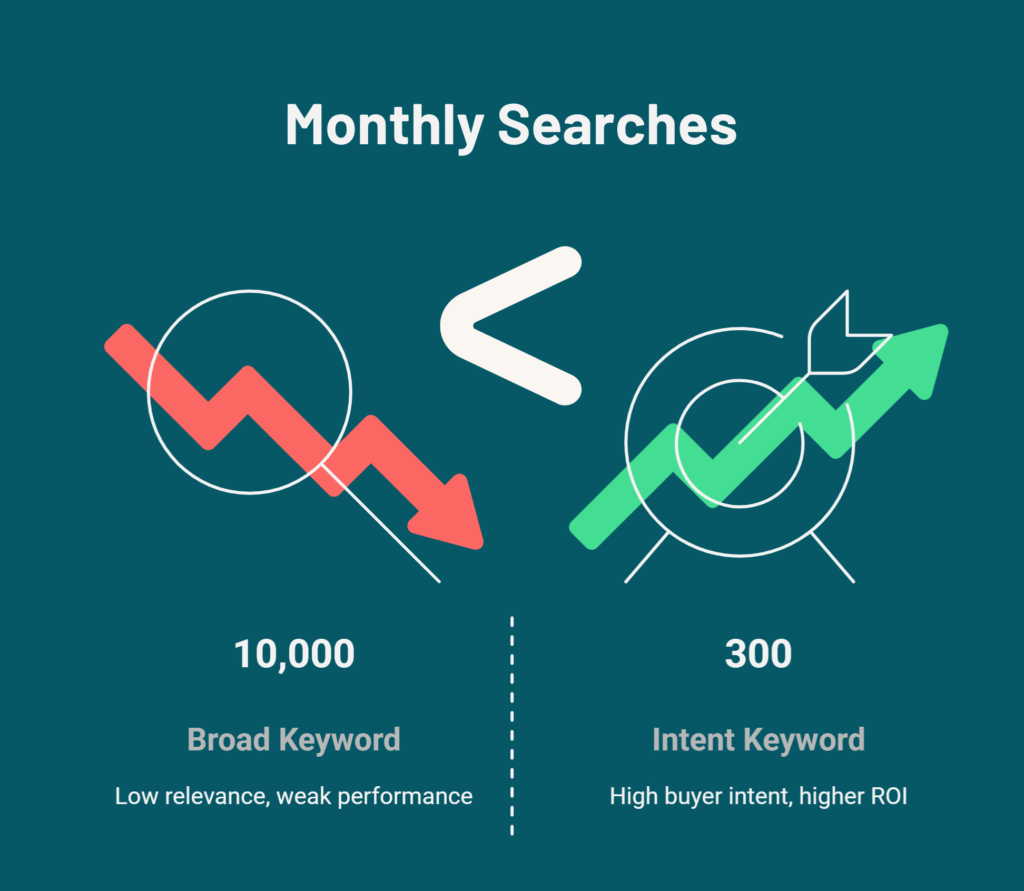
Keep in mind: A keyword with 300 monthly searches and clear buyer intent may outperform a broad one with 10,000 searches but low relevance.
Building a Keyword List That Matters
- Start from seed keywords (broad terms relevant to your niche).
- Expand using auto-suggestions and “People Also Ask” queries.
- Include both long-tail keyword variations and keyword strategies focused on semantic similarity.
- Create clusters that balance competitiveness and conversion value.
Sample Keyword Discovery Flow
- Input seed keyword → e.g., keyword strategy.
- Collect related terms → keyword planning process, keyword prioritization, search intent mapping.
- Add long-tail modifiers → how to create a keyword strategy for ecommerce.
- Analyze keyword difficulty and volume.
- Keep only terms that align with business goals and potential customers.
Step 3 – Classify Search Intent and Build Keyword Clusters
Search intent is the core of every effective keyword strategy in SEO. Google’s algorithms increasingly rely on semantic keyword mapping, meaning your content must match both context and purpose of the search.
Types of Search Intent
| Intent Type | Purpose | Example Keyword |
|---|---|---|
| Informational | Learn something | what is a keyword strategy |
| Navigational | Reach a brand or site | Yoast SEO, Shopify SEO |
| Commercial | Compare options | best keyword strategy software |
| Transactional | Take action | build a keyword strategy tool |
Understanding which keyword intent dominates your target keywords ensures your content format fits user expectations to boost search engine traffic and conversions.
Mapping Intent to Content Types
- Informational: Educational blogs, guides, FAQs.
- Commercial: Listicles, comparison posts, product roundups.
- Transactional: Landing pages, demos, sign-up flows.
Each type requires unique optimization. For instance, commercial intent keywords demand strong value propositions, while informational topics need comprehensive coverage and visual explanations.
Keyword Clustering Strategy
Use keyword grouping algorithms (for example, tools like semrush offer this feature of creating keyword clusters) or manual segmentation to group similar queries.
This approach minimizes content overlap and builds topical authority.
Steps for Clustering:
- Identify keywords with overlapping top-10 search results.
- Use term frequency analysis and keyword co-occurrence to confirm shared themes.
- Assign a primary keyword and related terms.
- Create one optimized page for each cluster.
Example of a Cluster Table:
| Cluster | Primary Keyword | Supporting Keywords |
|---|---|---|
| Keyword Planning | keyword planning process | keyword roadmap, keyword selection process |
| Search Intent | search intent mapping | intent segmentation, search intent classification |
| Keyword Clustering | keyword clustering strategy | keyword grouping algorithm, topic modeling |
Semantic Keyword Mapping and Topic Modeling
Modern search engines interpret context, not just repetition.
Use topic clusters to interlink pages under one pillar.
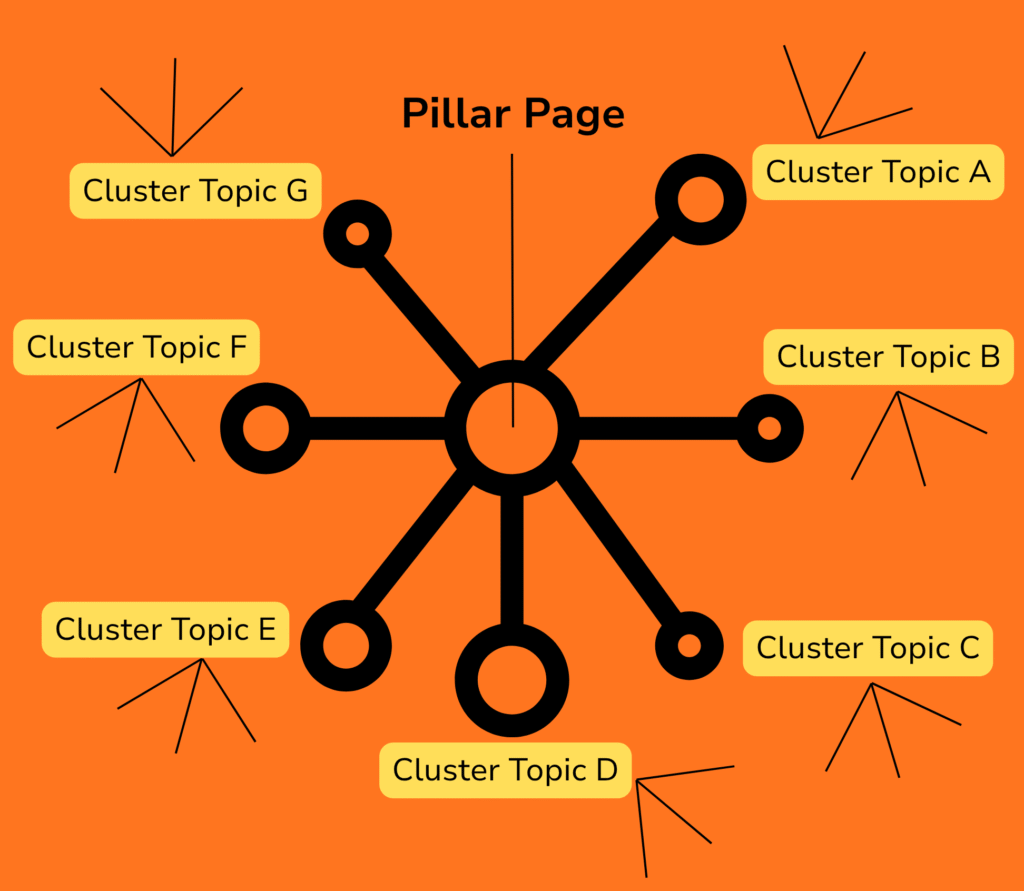
For example:
- Pillar: Keyword Strategy in SEO
- Cluster: Keyword Gap Analysis, Keyword Prioritization, Keyword Mapping Strategy, Keyword Strategy for Ecommerce.
This structure strengthens your internal linking and improves ranking potential across an entire theme rather than one page.
Key Benefits of Keyword Clustering
- Builds content authority and consistency.
- Reduces cannibalization between similar topics.
- Increases visibility for long-tail keywords.
- Helps with structured content planning and SEO content mapping.
Step 4 – Prioritize Keywords Based on Value and Ranking Difficulty
Not every keyword deserves equal attention. Smart prioritization ensures you spend resources where ranking and revenue potential align.
Scoring Framework
Evaluate each keyword on four primary dimensions:
| Factor | Description | Weight |
|---|---|---|
| Business Relevance | How closely the keyword aligns with your offering | 40% |
| Ranking Potential | Ease of ranking based on authority and competition | 30% |
| Traffic Potential | Possible reach across search results and variations | 20% |
| Effort Level | Content, links, and resources required | 10% |
Total Score = Weighted Sum → Use this to rank all keywords to target.
Keyword Evaluation Checklist
Use this keyword evaluation checklist to evaluate search trends and refine your strategy targets, ensuring every keyword aligns with audience intent and ranking potential.
- Does it match a business goal?
- What’s its search intent?
- What is its keyword difficulty score?
- Is the SERP dominated by brands or mixed results?
- Are there long-tail keyword alternatives with better chance of ranking?
- How does this keyword support conversion rates?
High, Medium, and Low Priority Tiers
Tier Description Example:
| Tier | Description | Example |
|---|---|---|
| High | Strong intent + achievable competition | keyword strategy template, keyword planning process |
| Medium | Moderate intent or higher competition | keyword clustering strategy, keyword mapping strategy |
| Low | Low traffic or informational-only | what is a keyword strategy, keyword definition |
Focus on high-value commercial intent keywords first, then build supportive informational content to feed internal links and authority.
When to Reassess Priorities
- Quarterly content audits.
- When business goals change (e.g., launching a new service).
- After significant search engine algorithm updates.
Step 5 – Map Keywords to Content and Optimize for Search Engines
Once you’ve built and prioritized your keyword clusters, the next step is to connect them to specific content pieces. This ensures every page serves a clear purpose and targets the right search intent.
Content Mapping Framework
| Content Type | Purpose | Typical Keywords |
|---|---|---|
| Pillar Page | Broad authority topic that anchors clusters | keyword strategy in SEO, keyword roadmap |
| Cluster Blog | Deep dive into subtopics supporting the pillar | keyword planning process, search intent mapping |
| Commercial Page | Product/service promotion | keyword strategy service, keyword optimization services |
| Landing Page | Conversion-oriented CTA | keyword strategy plan for website, keyword strategy template |
| FAQ or Resource | Supportive content, answer questions | keyword strategy step by step, keyword difficulty |
Each page should have a primary keyword, several secondary terms, and contextual semantic keywords that reinforce meaning and help identify search intent clearly.
Avoid Keyword Cannibalization
Multiple pages targeting the same keyword list confuse search engines. Assign unique topics, maintain a central spreadsheet of target keywords, and ensure internal linking clarifies relationships.
On-Page Optimization Essentials
- Titles and H1s: Include the primary keyword early.
- Subheadings (H2/H3): Add related keywords like keyword planning process, keyword prioritization, and ranking potential.
- Body Content: Keep density natural (≈1–2 %), add synonyms and context.
- Meta Data: Write unique meta titles/descriptions for each page using keywords to find better CTR opportunities..
- Images & Alt-Text: Use descriptive names such as keyword-strategy-process-diagram.png.
- Internal Links: Connect clusters logically using anchor text like keyword roadmap or SEO content mapping.
Pro Tip: Focus on clarity and usefulness first—keyword optimization is only effective when paired with reader value.
Technical SEO Considerations
- Ensure crawlability with XML sitemaps and consistent canonical URLs.
- Improve Core Web Vitals: load speed, interactivity, stability.
- Optimize for mobile and accessibility to satisfy Google’s UX signals.
- Use HTTPS and schema markup (FAQ/HowTo) where relevant.
Step 6 – Track, Measure, and Update Your SEO Keyword Strategy
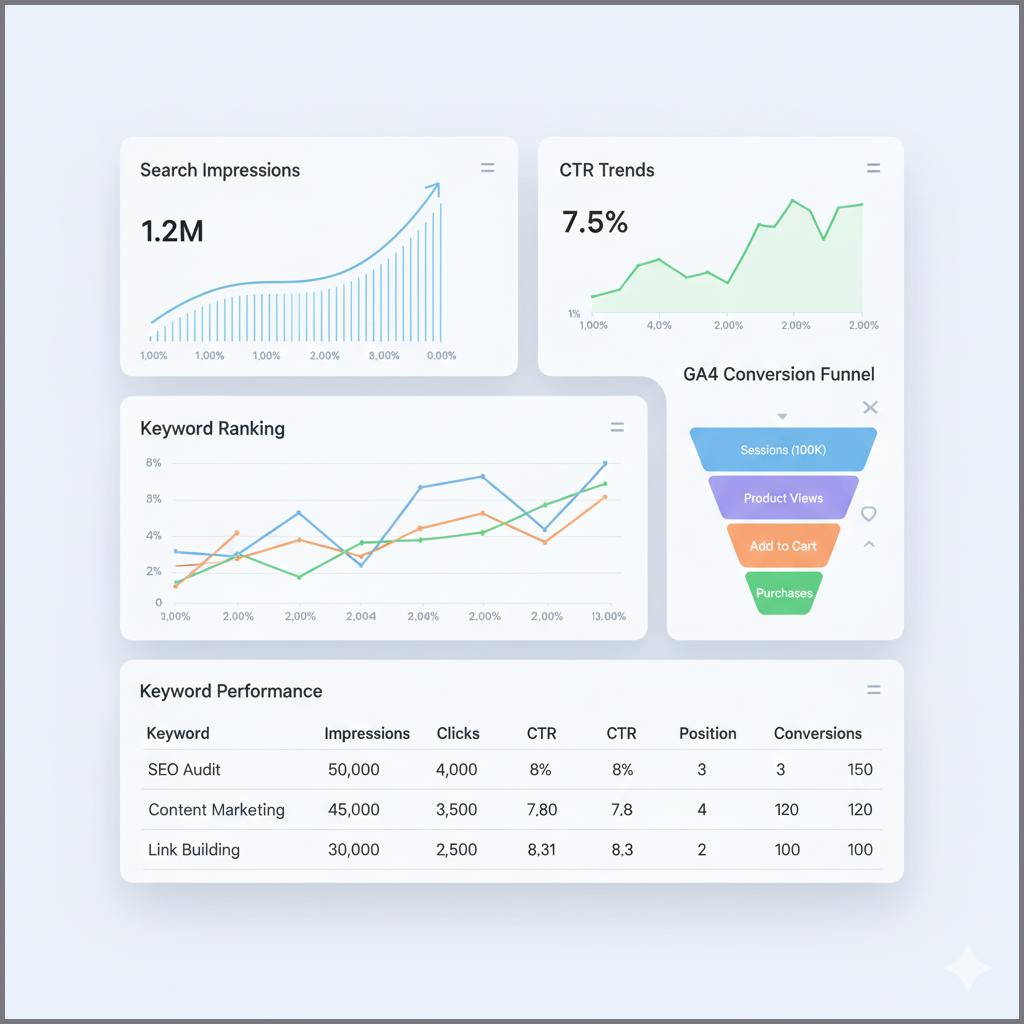
A keyword strategy isn’t static, it evolves with changing algorithms and audience behavior.
Your keyword strategy uses tracking and analytics to measure SEO performance and keep your content aligned with the latest search trends helping you discover different keywords that are easier to rank and deliver consistent traffc.
Tracking Tools and KPIs
| Tool | Metric | Purpose |
|---|---|---|
| Google Search Console | Impressions, CTR, positions | Identify ranking improvements and keyword opportunities. |
| Google Analytics 4 | Sessions, conversions, engagement | Measure organic traffic quality and outcomes. |
| Rank Tracker / Semrush / Ahrefs | Daily ranking shifts | Validate progress and detect volatility. |
Key Performance Indicators
- Average position of target keywords
- Growth in non-brand organic search traffic
- Conversion rates from organic sessions
- Share of voice versus competitors
Regular Keyword Performance Review
- Export ranking and traffic data monthly.
- Compare against your keyword roadmap to identify search wins and gaps.
- Refresh underperforming pages – update statistics, add FAQs, keywords with high intent but lower search volume to improve keyword relevance scoring.
- Identify new long-tail keyword trends via Search Console queries.
Updating content quarterly keeps it competitive and signals freshness to search engines.
Advanced Keyword Strategy Techniques (2025 and Beyond)
The next generation of SEO focuses on semantics, automation, and intent prediction.
AI Keyword Strategy Tools
- Use clustering algorithms that apply embeddings to detect keyword similarity.
- Employ AI SEO tools for outline generation, entity suggestions, and competitive gap analysis.
Keyword Research and Strategy Automation
Automate data pulls from APIs, schedule scoring updates, and integrate dashboards for real-time decision-making.
Entity Recognition and Semantic Search
Google now recognizes entities (brands, products, people). Building content around them strengthens topical authority.
Zero-Click and Generative SERP Adaptation
Provide concise, authoritative answers to win featured snippets and maintain visibility even in AI overview panels.
Keyword Strategy Templates and Practical Resources
A repeatable workflow saves hours of manual coordination and ensures consistency when managing different keywords across your site.
Keyword Strategy Template (Outline)
| Column | Description |
|---|---|
| Keyword | Primary term or phrase |
| Intent Type | Informational / Commercial / Transactional |
| Volume & Difficulty | From research tools |
| Business Relevance Score | Score 1–5 based on impact |
| Page Type | Blog, Landing, Product, Resource |
| Status | Planned / Live / Needs Update |
| Notes | Insights or next actions |
Store (copy/screenshot) this as a Google Sheet or project-management board to maintain visibility across teams and track branded keywords alongside generic ones.
How to Use the Template Effectively
- Add new keywords from research sessions.
- Assign owners and deadlines.
- Track publication status.
- Monitor results after indexing.
- Update scores each quarter.
Consistent documentation turns your keyword strategy template into a living asset.
Common Mistakes to Avoid in Building a Keyword Strategy
| Mistake | Why It Hurts | Fix |
|---|---|---|
| Chasing High Search Volume Only | Brings irrelevant visitors, low conversions | Balance with commercial intent and branded keywords |
| Ignoring Search Intent | Wrong content type ranks poorly | Classify every keyword before you create content |
| Duplicate Targeting | Causes cannibalization | Use a single page per cluster |
| Never Updating Content | Rankings drop over time | Schedule quarterly reviews |
| Skipping Tracking and KPIs | No insight into ROI | Implement keyword tracking and monitoring tools |
Remember: a good keyword strategy prioritizes relevance + ROI, not just volume.
Real Case Study: Keyword Strategy Boosting Traffic by 120%
A mid-size B2B software company suffered flat organic traffic despite heavy blogging.
Analysis showed hundreds of unstructured posts and overlapping topics.
Approach
- Conducted keyword gap analysis using keywords into Google and competitor benchmarks.
- Built 12 keyword clusters tied to purchase stages.
- Implemented pillar and cluster model with clear keyword hierarchy.
- Prioritized long-tail keyword sets with moderate keyword difficulty.
- Tracked progress via Google Search Console dashboards.
Results (After 6 Months)
- +120 % increase in qualified organic sessions.
- Average position improved from 34 → 9 for 30+ target terms.
- Conversion rate rose 40 % due to better intent alignment.
The project proved that structured planning—not more content—delivers predictable growth.
Frequently Asked Questions (FAQs)
1. What is the difference between keyword research and keyword strategy?
Keyword research gathers possibilities; a keyword strategy organizes, prioritizes, and applies them to achieve rankings and business goals.
2. How do I prioritize keywords for SEO?
Focus on keywords are often evaluate based on difficulty, intent, and revenue potential.
3. What is a keyword cluster?
A group of related search terms that share intent and can be served by a single, comprehensive page.
4. How often should I update my keyword strategy?
Review quarterly or whenever new services, competitors, or major algorithm changes arise.
5. Which tools are best for building a keyword strategy?
Combine free and paid options such as Google Keyword Planner, Semrush, Ahrefs, Frase.io, or other keyword strategy tools to use to find new opportunities and measure performancethat suit your workflow.
Building a Sustainable Keyword Strategy in 2025 (Conclusion)
A winning keyword strategy connects audience intent with your brand’s expertise.
By systematically researching, classifying, and mapping specific keywords, you transform search visibility into measurable business outcomes.
Remember these essentials:
- Always align keywords with business goals.
- Focus on search intent and content quality over quantity.
- Use structured clustering and regular keyword performance review.
- Keep refining through data tracking and strategy updates.
Search landscapes evolve, but the principles of relevance, authority, and trust remain timeless.
Build a plan today that serves both your readers and search engines and your keyword strategy for SEO for 2025 will continue delivering results for years to come.